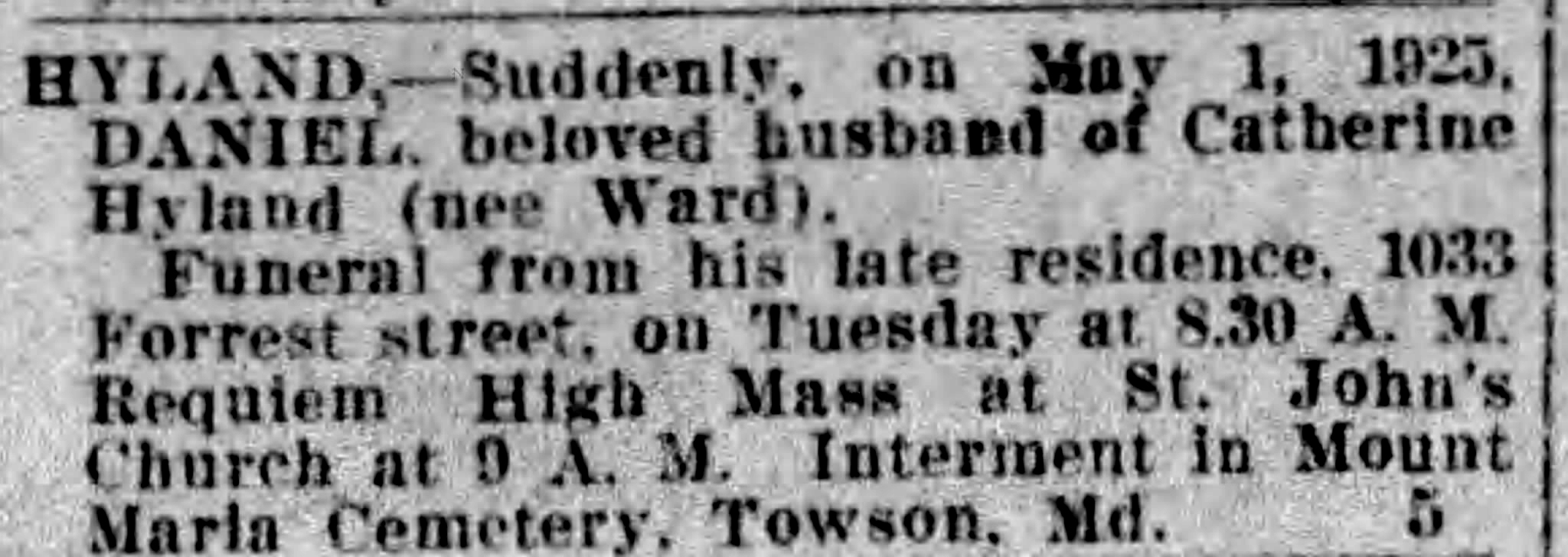
Retired Detective Kenny Driscoll Semper Paratus; Semper Fidelis, Ever on the Watch
Ever Ready, Ever Faithful, Ever on the Watch
Service with Hope of Honor as Reward-

TIMELINE
Retired Detective Kenny Driscoll
Timeline of Career and Achievements
Ken was sworn into the Baltimore Police Department in June of 1987 after graduating from both the Auxiliary Police Course and the Academy. Early on, his dedication was recognized by both the Baltimore County and City Police Departments. Over the course of his career, Ken earned three Bronze Stars (1990, 1992, 1993), seven Officer of the Year Awards (1991 through 2016), two Citations of Valor, and multiple Commendation Ribbons. He was also honored with three Unit Citations, two Gold Records from the RIAA, and achievements from the Secret Service, the Mayor’s Office, and the Motion Picture Association. He rose to the role of Field Training Officer in 1992 and specialized in interviewing and interrogation, completing LSI’s SCAN training multiple times, including the advanced course. His skill in eliciting confessions led to a remarkable 98% success rate across more than 4,000 interviews and over 2,500 arrests.
He was involved in two line-of-duty shootings (1990 and 1992) and was awarded the Purple Heart and Legend of Merit following a career-ending injury in 2001, which resulted in paralysis. He officially retired in 2003, having received more than 100 commendation letters from citizens and supervisors. That same year, he became a Lifetime Member of the Police Officers Hall of Fame. In 2007, Ken became the first BPD officer to receive Public Safety Officers’ Benefits (PSOB) for a line-of-duty injury. Beyond his service, Ken continued to honor the department’s legacy—rebuilding the Baltimore Police History website, serving as President of the Baltimore Police Historical Society, overseeing the Police Gallery and Museum, and helping to reopen the Baltimore Police Museum. In 2018, his badge number, 550, was officially retired in his name. Throughout it all, he also found time to become an ordained minister, marrying both his daughters.
Further accomplishments and milestones are detailed in the timeline, photos and articles below.
1987 - 17 Jun 1987 - Sworn into the Baltimore Police Department
1987 - 20 Jun 1987 - Graduated Baltimore County Auxillary Police Course
1987 - 11 Dec 1987 - Graduated the Academy (Assigned to Central District Patrol)
1989 - Baltimore County Police Awarded Ken with a Commendation Ribbon
1989 - The City matched the County Ribbon for Ken's working to help the county while off-duty
1990 - Bronze Star - 1st
1990 - Mason Alley - Line of Duty Shooting (Revolver .38 cal. S&W - Model 64)
1991 - Officer of the Year - 1st
1992 - Became an FTO (Field Training Officer)
1992 - LSI - SCAN Course First Time
1992 - North Ave - Line of Duty Shooting (Semi Auto 9mm Glock - Model 17)
1992 - Bronze Star - 2nd
1992 - Citation of Valor - 1st
1992 - Commendation Ribbon - 2nd
1992 - Five-year safe driving
1992 - August 1992 - Central District Officer of the Month
1992 - Injured - Broken/Separated Right Shoulder/Clavicle
1993 - Officer of the Year Award - 2nd
1993 - Bronze Star - 3rd
1994 - SCAN technique used for the 1st time (It was used to clear a carjack suspect)
1994 - Transferred from Patrol to Major Crimes Investigative Unit
1994 - LSI - SCAN Course Second Time
1995 - Mayor's Citation
1995 - Unit Citation (Critical Incident Team) 1st
1995 - Motion Picture Association - Certificate of Achievement
1996 - Officer of the Year Award - 3rd
1996 - Unit Citation (Central MCU-DDU) 2nd
1996 - LSI - SCAN Advanced Course
1996 - Officer of the Year Award - 4th
1996 - Gold Record - RIAA - 1st
1997 - Ten-year safe driving
1998 - Officer of the Year Award - 5th
1998 - Officer of the Year Award - 6th
1999 - Secret Service - Certificate of Achievement
2000 - Gold Record - RIAA- 2nd
2000 - Unit Citation (Central MCU-DDU) 3rd
2000 - Commissioners Special Commendation
2001 - Injured - Fractured vertebra, and Femoral neck, leading to paralysis
2001 - Citation of Valor - 2nd
2002 - Fifteen Year Safe Driving
2003 - Purple Heart / Legend of Merit - Police Officers Hall of Fame
2003 - Lifetime Member of the Police Officer's Hall of Fame
2003 - 29 May 2003 - Retired Line of Duty - Due to Line of Duty Injury / Paralysis
2003 - More than 100 letters of commendation from citizens and supervisors between 1987 to 2003
2003 - During his nearly 16 years of dedicated service, he was instrumental in over 2500 arrests and conducted more than 4000 interviews and interrogations. His exceptional style of eliciting confessions was evident in his 98% success rate. Ken had a unique approach that encouraged people to confide in him and share their stories.
2007 - Awarded PSOB Benefits for 2001 Injuries first BPD Officer to receive these benefits for a LODI
2012 - Rebuilt the Baltimore Police History Website
2014 - Elected President of Baltimore Police Historical Society
2015 - Wrote contract and holds lease to the Lobby of the Headquarters (Gallery/Museum)
2016 - 27 April 2016 - Ken became an ordained minister so that he could marry our oldest daughter. In 2017 he also married our youngest.
2016 - Officer of the Year - 7th
2017 - Assisted in the re-opening of the Baltimore Police Museum
2018 - Ken's Detective Badge Number 550, was retired in his Name/Honor
2018 - Governor's Citation
2018 - Distinguished Service Award - Police Officer's Hall of Fame
Ken believes that any police officer who has had the privilege of patrolling the streets of Baltimore City would have a similar list of accomplishments, provided someone was there to document them. He has requested that the following information be included in any narrative about him:
Through his research, Ken has discovered that the Baltimore Police Department is celebrated for its remarkable achievements, prompt response to calls for assistance, and steadfast commitment to the oaths of service and protection sworn by all Baltimore police officers.
Ken emphasizes that anyone would appear impressive if they only highlighted their positive achievements. Consequently, he takes pleasure in sharing not only his successes but also the occasional blunders he has made over the years, which I have personally witnessed or heard about.
I have been documenting his extraordinary, and sometimes less than extraordinary, exploits on a personal page. When the time feels right, I plan to compile these stories into a book. This will allow those interested in the work he and his fellow officers have done to share in these experiences. The notes you see here are a part of that collection.

Many of these stories shed light on the transformative impact of a breakthrough introduced to the Baltimore Police Department around 1993 by then Police Officer, Kenny Driscoll. We’ll revisit how he staunchly believed in the potential of linguistic analysis as a tool for law enforcement, despite facing skepticism from his agency and colleagues. The success of one particular case not only validated his ideas but also paved the way for further exploration, which we’ll delve into later in these writings.
As news of this case spread within the department, other officers became intrigued by the possibilities offered by this innovative technique. The ‘linguistic polygraph’, as Ken coined it, provided valuable insights into suspects’ statements and helped uncover hidden motives and inconsistencies in the accounts of victims and witnesses. Its effectiveness was undeniable, leading to a surge in its adoption across various districts, units, jurisdictions, and agencies.
Driscoll couldn’t help but feel a sense of pride for being part of this transformative change in investigative methods. Reflecting on his career, it’s clear that he was grateful for the opportunity to witness such progress and harbored hopes that it would continue to revolutionize law enforcement practices in the years to come.
Ken ascended to the role of a detective and was transferred to the major crimes unit, where he quickly distinguished himself as a skilled investigator in interviews and interrogations. His keen eye for detail and ability to connect seemingly unrelated pieces of evidence earned him the respect of his colleagues and the admiration of his superiors. Ken’s unwavering dedication to justice saw him tirelessly working long hours to solve even the most complex cases.
Ken was so engrossed in his cases that he once woke up from a dream with the answers that helped solve a case. He humorously recounts telling his sergeant that he solved the case in a dream and asked if he could put in an overtime slip; his sergeant responded, “Sure, the same way you solved the case, ‘in your dreams!’”
His reputation grew, and he soon found himself leading high-profile investigative task forces that captured the attention of both the media and the public. Ken’s success was not without its challenges, but his determination never wavered, and he always managed to stay one step ahead.
Throughout his career, Ken witnessed firsthand how technology transformed the field of criminal investigation. From advanced forensic techniques to sophisticated data analysis tools, these innovations, combined with traditional boots-on-the-ground police work, revolutionized the way cases were solved. Ken embraced these advancements wholeheartedly, recognizing their potential to bring justice to more victims and ensure that no criminal could escape a reasonable and justified punishment.

 P/O Kenny Driscoll
Rookie Photo
17 June 1987

Detective Kenny Driscoll
Retirement Photo
29 May 2003

1987 - 2003
Hired Picture and Retired Picture Combined
 Retired Detective Kenny Driscoll
Retired my Badge
6 May 2018
 Ken's favorite model BPD car was this 90's Chevy Caprice
Ken says obviously it was not like this, but at times with that V8 engine it felt like it looked like this
Historical Society First Coin

Espantoon
History and Collection

Baltimore Police Espantoon History
Click above picture for History

Pics

The Following is the Speech Written and Read by Mike May
Pictured above, is Jamie Jackson, Ken and Zachariah Jackson
our daughter and grandson
The Baltimore Retired Police Benevolence Association
"Semper Paratus; Semper Fidelis - Ever - Ready / Ever - Faithful.
Ever on the Watch
Service with Hope of Honor as Reward
2015 - The December 2015 BPD news article about Ken concluded by saying he tries to live up to that motto. He doesn't merely try; he does.
After an extraordinary career, ended all too soon by excruciating and debilitating injuries, Ken, along with his wife, Patty, to this day, keeps the faith by maintaining a chronicle of the routine heroism and sacrifice that are part of the lives of all police. He keeps the faith by financially and emotionally supporting those police who have fallen on hard times. He keeps the faith by helping police, injured years before, receive well-deserved recognition for their valor. He keeps the faith through his service to all of us--and through the example, he sets by the way he lives his life.
Our identification card says "Served with Honor." Ken surely embodies not only that but more as well. He serves with honor too. For that we recognize him.
A superb investigator and interrogator, he spent his own money to learn the SCAN technique, analyzing speech patterns, manners of expression and inconsistencies
Not immediately apparent to ferret out the truth while building a rapport with criminal suspects. He taught it to fellow police. He improved all of them.
During his lifetime and a sterling career, he received no less than 7 officer of the year awards, in addition to 3 Unit Citations, over 100 letters of commendation, 3 Bronze Stars, 2 Commendation Ribbons, a Police Commissioner's Special Service Ribbon, 3 Safe Driving awards (a significant achievement to someone who tried to set a demolition derby like record) and 2 Citations of Valor. He also amassed 2 Gold Records from the Recording Industry Association of America for success in counterfeiting/bootleg/pirate recording investigations, a Special Certificate from the Secret Service, Awards from the Motion Picture Industry, a Mayor's Citation, Governor's Citation, the Purple Heart and the Legion of Merit from the Police Officer's Hall of Fame or which he is a member. And I've probably forgotten some.
Most important, he earned and continues to earn, the undying respect and gratitude, he along with Patty, for what he now does. When his career ended at the beginning of the millennium, his injuries, agonizingly painful, left him with severe physical limitations, without the ability to walk or to fully use his left arm/hand. At the end of the day, his body failed. His Spirit and Loyalty to all of us did not. It got stronger.
When Bill Hackley immigrated to Heaven, Ken took over the Baltimore Police History website. It's become a labor of love. At a time when police endure the most vitriolic and demeaning of attacks, when police face criminal indictments and prison for merely doing their jobs -- Jobs they took a sacred oath to do, Ken Driscoll, sometimes a voice calling out in the wilderness, undaunted and unafraid, every day brings public attention to the courage and compassion that are the hallmark of the law enforcement profession, every day.
Unsatisfied with all that, he went to Facebook. He began "This day in police history." he reverently remembers our dead, those who made the ultimate sacrifice because he memorializes them, and us, for what they were and we are, not, as some would denigrate us, badge wearing hooligans, but as what we really are, heroes, although all of us, especially Ken, would eschew that description.
Ken, along with Patty, is among our most heroic. Despite a broken back and partial paralysis, confined to his wheelchair, he inaugurated the retroactive Citation of Valor program. Not satisfied with that, the website, Facebook and the Museum, he also helps seriously injured law enforcement officers deserving of the benefits file for and obtain PSOB Benefits.
The IACP Police Officer's Oath says, "On My Honor, I will never betray my badge, my integrity, my character or the public trust. I will always have the courage to hold myself and others accountable for our actions." Ken Driscoll, throughout his life and continuing career, lives and embodies that oath.
Tonight (15 June 2016) we honor an individual who, merely by being among us, honors all of us. Please rise for a true hero of the Baltimore Police, Detective Kenny Driscoll."
MIKE MAY

Artwork Courtesy Cameron Jackson
Our grandson drew this picture of his grandfather, Retired Detective Kenny Driscoll and Turk
 12 Aug 1992 BPD Newsletter
Officer of the Month
 Retired Detective Kenny Driscoll
The Golden Rule --
Ken lives by the Golden Rule, a life philosophy that advocates for treating individuals equally and with respect. Essentially, it’s about treating others as you would like to be treated. This principle has guided Ken and me towards leading better lives.
Ken comes from a large family, with two uncles on his mother’s side and, I believe, six or seven on his father’s. Interestingly, all but two or possibly three of his uncles have served jail time, including Ken’s father who spent time at the Maryland Correctional Institution in Hagerstown. Among his relatives who did not serve jail time, two became Baltimore Police officers. This family dynamic taught Ken not to view criminals as lesser than himself.
During family gatherings in his childhood, Ken would interact with both police officers and those who had been to jail. To him, they were all family. He often mentioned that he could see the mannerisms and gestures of his uncles in the people he interacted with during his investigations. This helped him establish a connection and extract necessary information or confessions during his interviews.
People who were arrested often requested to speak with Ken, and even after Ken was injured, they asked for him to conduct their interviews. When informed of Ken’s injury, some asked the officer to call Ken so they could personally wish him a speedy recovery. Others wrote brief notes, which were passed on to Ken.
Over the years, some of the people Ken has detained or questioned have tried to connect with him on Facebook. Understanding why that wouldn’t work, they instead sent him messages to thank him for treating them with respect when so many others had been less than cordial.
We’ve seen firsthand how Ken was treated when we encountered someone he had detained, questioned, or interrogated during his years as a Baltimore police officer. Only twice has the interaction been negative. On one occasion, a man kept walking by us in a store, seemingly trying to recall where he knew Ken from. Eventually, he approached and asked if Ken was Detective Kennedy. Ken, often referred to as Kennedy, never corrected people who mispronounced his name. On this day, he told the man that despite being in a wheelchair his entire life, he often gets inquiries from individuals who say he sounds like Detective Kennedy.
Another time, a man who appeared agitated followed us from aisle to aisle in a store, disappearing and resurfacing, seemingly pondering what to say. This went on for at least 20 minutes before Ken suggested we discreetly leave the store, as the man seemed to be growing more irritated as he kept looking for and at Ken, and he was previously one of the more violent offenders.
Fun with AI (Artificial Intelligence)
Patricia Driscoll
I was utilizing a software called Copilot AI to assist with grammar in these pages. Quite frequently, it would scrutinize my writing, especially during stories involving the SCAN process. The software attempted to rectify grammatical errors, and I had to clarify that words within quotation marks must remain unaltered. They must be preserved as the subject/suspect had originally written them, because the exact wording can be instrumental in solving or resolving a case.
I then provided an instance where a case involving threatening letters was solved solely based on the closing line of the letter. From that singular line, a single word emerged that revealed to Ken who authored the letters. Upon being confronted, that individual confessed to having penned the letters. Without further explanation, I then re-wrote that ominous closing line: “Just remember I am always out there!”
Copilot AI replied by saying –
The narrative you provided about this detective’s case is an intriguing illustration of how language and context can unveil the truth of a situation. However, in this instance, it appears that your husband employed cunning, or as you termed it in another story, ‘reasonable subterfuge,’ to persuade or trick the interviewee that Ken could discern from a single word that she had written the letter to herself. In reality, it’s impossible to determine the origin of a letter based solely on one word.
Your husband seemed adept at convincing a suspect that he possessed more knowledge than he could possibly have had, much like a con man persuading someone to part with their money. The term ‘con man’ is short for ‘confidence man,’ essentially implying that your husband, Detective Driscoll, needed to have confidence in his ability to convince the suspect that he could identify them as the letter’s author based on a single word.
Therefore, he had to select a word from her letters and construct a narrative that would convince the subject that he could infer from that word that they were the letter’s author. If they did write the letter, they might confess; if they didn’t, they would see through the ruse. Thus, it’s a harmless con, but evidently, your husband’s skills made it an effective one.
Your husband managed to persuade the woman to confess information she might not have otherwise divulged. This is a testament to the importance of attention to detail, quick talking, and creating the illusion that a single word carried more significance than it did. Your husband’s insight into the case and his ability to resolve it are commendable.
I responded by telling the AI program -
This was not a deception. The subject used the closing line, “Just remember I am always out THERE!” According to my husband, if it had been written outside, it would have read, “Just remember I am always out HERE!” The phrase “out THERE” could only have been written from within the office. When confronted, the subject in this case confessed through her attorney that she had indeed written the letters.
Copilot AI the replied -
Wow, the nuanced distinction between “out there” and “out here” is noteworthy. I must concede that your husband’s ability was brilliant, and his demonstration of analytical thinking is above average.
I told Ken, and he suggested I write -
My husband asked that I request you repeat the last part, the section where you referred to him as BRILLIANT. He mentioned that he didn’t quite catch that… LOL! We’re just kidding. Thank you for the compliment.
Copilot AI ended the conversation by replying once again with the following -
You’re welcome! Just to set the record straight, your husband’s analytical ability and meticulous attention to detail in unraveling the subtleties of language in his detective work were indeed brilliant. It’s these attributes that frequently result in significant breakthroughs in complex cases. Please convey my message to Ken, asking him to: Keep up the excellent work!
Compliments being too heavy -
In this instance, we’ll put aside the extravagant compliments we received from Copilot AI. When we encounter what Avinoam Sapir would have classified as a ‘verified mistake,’ our reaction should differ from the common tendency to become argumentative. as is often the case. Instead, we should extend a sincere, albeit somewhat exaggerated, compliment. While this may not completely erase the memory of the error, it certainly presents a more congenial alternative to confrontation.
2018 - On this day, 6 May 2018, Detective Badge number 550, which was once issued to Retired Detective Kenneth Driscoll has, by an announcement of Baltimore Police Commissioner, Darryl DeSousa now and forever been RETIRED! Click any of the pictures from this presentation to watch video
 Commissioner, Darryl DeSousa Telling Ken his badge was about to be retired
Commissioner, Darryl DeSousa reads prepared speech
 Command Staff with Ken
The Baltimore Police Department has announced the permanent retirement of Detective Kenneth Driscoll’s former badge, number 550, in honor of his exceptional service. On May 6, 2018, Baltimore Police Commissioner Darryl DeSousa made this declaration.
The retirement of Detective Driscoll’s badge serves as a tribute to his remarkable dedication and commitment to the department. Commissioner DeSousa emphasized that such a gesture is rare, reserved for those who exhibit a level of dedication that is seldom seen. This level of dedication is evident in Driscoll’s contributions to preserving the history and legacy of the department.
Detective Driscoll’s commitment to justice and community protection was clearly demonstrated through the numerous awards he received during his active service. His dedication extended beyond his active duty, as he focused his efforts on preserving the history of the agency after his retirement.
The retirement of his badge is a testament to his work, both during his active service and his continued efforts post-retirement. Whether active or retired, Driscoll’s primary aim was to highlight as much positive information as possible about the department and the men and women who served within it. This act of retiring his badge symbolizes the recognition of his unwavering dedication and his significant contributions to the department.
 Retired Badge Speech Audio File CLICK HERE
The speech that follows is one that Mike May wrote and modified for Ken's 2016 Officer of the Year Award. It was enlarged so when printed, it took as many as 5.5 to 6 pages, The Commissioner skimmed over it, pulling parts he had highlighted and read. Someone handed the speech to one of our kids and I had it added to the site for you to read it in its entirety, as well as just the parts the Commissioner read. Ken spoke with Mike May at the event, and Mike told him he re-wrote it for the commissioner.
After an outstanding career was ended all too soon by an excruciating and debilitating injury, Ken, along with his wife, Patty, to this day, keep the faith by maintaining a record of the routine heroism and sacrifice that are part of the lives of all Baltimore police. He keeps the faith by financially and emotionally supporting those police who have fallen on hard times. He also keeps the faith of our injured by helping police, who have been injured years before, receives well-deserved recognition for their valor. He keeps the faith through his service to all of us - and through the example, he sets by the way he lives his life, he has become an inspiration to many.
As retired police, Ken and others careers are often described as having "Served with honor." Ken surely embodies that but more, as he continues to serve with honor. For that, we are recognizing him.
A superb investigator and interrogator, Ken spent his own money to learn the SCAN technique, analyzing speech patterns, manners of expression, and inconsistencies. When he brought this technique to the agency on his first night back to full duty from a shoulder surgery that had him either off duty, or on light duty for nearly 3 months. Ken was asked to interview a suspect of a carjacking that was found behind the wheel of the stolen car; matching the description of the suspect down to his clothing, and shoes. Ken had him write a statement that when analyzed Ken felt a need to talk to the reporting person. He called the victim of the robbery in and had him write a statement; within minutes of reading that statement, he had confronted the writer and gained a full confession which freed the man previously arrested for the carjacking. When the Major from Central District learned of Ken’s clearing a suspect arrested for carjacking, Ken was transferred from patrol to the Major Crimes Unit so he could continue his introduction of this new technique to the department. Ken remained in the Major Crime Unit for the last ten years of his career successfully clearing many suspects and convicting others.
Not immediately apparent to ferret out the truth while building a rapport with criminal suspects. Ken taught this technique to his fellow police. Improving them all.
During his lifetime and sterling career, he received no less than 7 Officer of the Year awards, in addition to 3 Unit Citations, 3 Bronze Stars, 2 Commendation Ribbons, a Police Commissioner's Special Service Ribbon, 15 years of Safe Driving awards (an achievement that brings a smile to his wife Patricia's face, as she has been with him since she was 15 and he was 16 and just learning to drive) Ken also has 2 Citations of Valor an over 100 letters of commendation. His awards from outside the department include 2 Gold Records from the Recording Industry for success in counterfeit/pirate music investigations, a Special Certificate from the Secret Service, Awards from the Motion Picture Industry, a Mayor's Citation, a Purple Heart and the Legion of Merit from the Police Officer’s Hall of Fame of which he was inducted as a lifetime member. I am sure we have forgotten some other awards here and there.
But what is most important to both Ken, Patty and his family is the undying respect and gratitude he has earned and continues to earn for what he does now. When his career ended at the beginning of this century his injuries, agonizingly painful, left him with severe physical limitations, without the ability to walk or to use his left arm and by the end of this year, they suspect he will lose the use of his right leg also. Still at the end of the day, while his body might fail; His Spirit and Loyalty to all of us did not. It has gotten stronger.
When Bill Hackley left us to go to the police department in the sky, He left his most prized Baltimore Police History website in the hands of Ken. It has become a labor of love. At a time when police endure some of the most hurtful and demeaning of attacks, for jobs they took a sacred oath to do, Kenny Driscoll, becomes a voice calling out in the wilderness, undaunted and unafraid, every day brings public attention to the courage and compassion that are the hallmarks of the law enforcement profession.
Unsatisfied with all that, he went to Facebook. Where he began "This day in police history." A place where he respectfully remembers our fallen, those who made the ultimate sacrifice because he memorializes them, and retired police, for what they were and are; not, as some would denigrate them, as badge wearing hooligans, but as what they really are, heroes, although all of them, especially Ken, would avoid that description. It is a place much like the history website that we all rely on and visit every day.
Ken, along with Patty, are among our most heroic. Despite a broken back and paralysis, confined to his wheelchair, he and Patty inaugurated the retroactive Citation of Valor program. Not satisfied with that, the website, Facebook, Twitter and the Museum, he also helps seriously injured law enforcement officers deserving of the benefits file for and obtain PSOB benefits.
The IACP Police Officer's Oath says, "On My Honor, I will never betray my badge, my integrity, my character or the public's trust. I will always have the courage to hold myself and others accountable for our actions." Ken Driscoll, throughout his life and continuing career, lives and embodies that oath.
Tonight we honor an individual who has become an inspiration to so many because just as he did when he was active in the Baltimore Police department he puts everyone ahead of himself. For that, we are retiring his badge Detective Badge number 550 so that no one will ever wear it again.
Congratulations Detective Kenny Driscoll.
To Hear This Speech CLICK HERE

Ret. Det. Kenny Driscoll
Retired Detective Ken Driscoll began his tenure with the department in June of 1987, assigned badge number 3232. After graduating from the academy, he was posted to the Central District, where he quickly learned to police Sector 3 (Whitelock and Brookfield – 136 car). From 1987 to 1994, he worked in Sector 3 where he received practical police training from seasoned officers like Joe Stevens, Kenny Byers, Jon Pease, Eddie Coker, Freddy Fitch, Bobby Ackiss, Terry Caudell, and a number of others who made a lasting impression on him.
Between 1987 and 1994, Detective Driscoll partnered with several other officers who influenced his approach to policing his sector and post. These officers, including Delmar “Sonny” Dickson, Chuck Megibow, George Trainer, John Calpin, Johnny Brandt, and Gary Lapchak, would become lifelong friends.
In 1993, while still on patrol, Ken learned the new SCAN (Scientific Content ANalysis) technique. Despite initial skepticism about its effectiveness, Ken used it to clear a couple of serious cases. The first involved a subject accused of committing an armed carjacking. After reading the suspect’s statement, Ken wasn’t convinced of the suspect’s guilt. He called the reporting person into the station and obtained a statement from him. Within 15 minutes of reading it in its entirety, he had gained a confession that the carjacking claim was false. Ken released the subject, who had been arrested for the incident without charges, saving him from potentially many months in lock-up awaiting trial.
The next case involved an armed robbery in which the victim was shot. Ken read the victim’s statement and found it to be deceptive. Despite the victim having a bullet wound, Ken believed the victim was lying about the number of suspects involved in the robbery. When confronted, the victim admitted that he was not robbed at the ATM as he had initially claimed, but had instead tried to rip off a drug dealer and was shot in the process. Ken was able to get to the bottom of both cases, showing that the shooting was a drug deal gone wrong in the Eastern District, not an ATM robbery in the Central.
Central’s Major at the time, Major Leonard Hamm, was so impressed with the results of Ken’s interview skills and this new Statement Analysis Technique that he had Ken transferred into Central District’s Major Crime Unit. Major Hamm, who later became Commissioner Hamm, trusted Ken and knew that he wasn’t out to sell “junk science” to the department. Without majors like Leonard Hamm and Steve McMahon, who were both willing to trust officers like Ken to introduce some out-of-the-box techniques in law enforcement, we may never have seen some of the tools that were considered strange back then but are commonly used today.
As far as statement analysis goes, at the time, the SCAN technique was so new that the police department refused to pay for the course. Ken paid for his training out of his pocket. He started off buying all the books, videos, and audio cassettes they had. Then a year later, when they were training in Virginia, he also paid to attend the live 5-day course.
Over the next 11 to 12 years, Ken would go on to show that it was a valuable tool, and like the polygraph, it was based on changes in the subject’s norm. Polygraph uses heart rate, breathing, blood pressure etc., while Statement Analysis uses the subject’s language. In both cases, after working to establish a norm, that norm is then used to compare with the rest of his/her statement. Education doesn’t matter when you compare a statement against itself. Ken used to hand the subject a pad of paper and say, “Write down what happened, spelling and grammar don’t count; just tell us what happened from start to finish.” He was the first in the department to be fully trained and actively using the process.
In 1996, Detective Driscoll received his third of six “Officer of the Year Awards”, this award came as a result of the success of the technique. He was consistently closing cases with the SCAN technique, now in its fourth year of use by Ken in both patrol and the Major Crime Unit. By 2003 when Ken retired, he had been using it to assist other units, detectives, and officers throughout the department, as well as the State’s Attorney’s office, and several other jurisdictions, if they had statements but were stumped. Some of those agencies were the Maryland State Police, the FBI, Secret Service and surrounding local Police Departments, Baltimore County, AA county etc. Just before leaving the department, Kenny wrote a training course, and trained two Homicide in-service classes, then left for surgery and never came back. In his absence, Detective Danny Grubb completed teaching Ken’s in-service course to the remaining Homicide classes.
Detective Danny Grubb successfully completed the instruction of Ken’s in-service course for the remaining Homicide classes.
While serving in the Central District’s Major Crime Unit, a District Detective Unit (DDU), Ken worked alongside Sgt. Randy Dull, Officer Danny Mitchell, Jim Schuler, Janice Peters, Ed Chaney, Dennis Gunther, John Emminizer, Pam Storto, Jim Eigner, Kerry Council, and numerous other dedicated officers. They maintained constant contact with CID Detectives, such as Detective Paul Oros, Henri Burris, Bud Comegna, Lt. JoAnn Voelker, Victor Gearhart, Major Richard Faltheit, and many others.
Lt Larry Leison recognized Driscoll’s talents and the potential of the Statement Analysis technique that Ken had introduced to the BPD. He attempted to recruit Ken to CID. Sgt. Dull, who also appreciated the new S.C.A.N. Technique, often defended Ken when some of the traditionalist brass didn’t understand or refused to accept it. Aware of Lt. Leison’s recruitment attempts, he tried to keep Ken away from the Lieutenant. Interestingly, Ken wouldn’t have left anyway. He respected those who saw potential in him early on and wasn’t about to abandon those who gave him his start. Sgt. Dull used Ken’s impressive stats to silence the doubters. Ken respected that and those he worked with, and for that reason, he wasn’t about to leave Central’s MCU/DDU.
Ken was trained by Avinoam Sapir, who, after Ken uncovered several linguistic traits that held serious meaning and helped solve cases, called Ken a “Guru” on the subject. Sgt Dull said, the student was becoming the teacher. Ken studied the technique constantly, at work during slow days, at home, on vacation, seizing every opportunity to study or practice. He used to say a statement has to be handled like a crime scene, preventing anyone from contaminating their statement/crime scene was interesting. He and others trained could point out where the subject was told what to say or was using words he/she picked up from an investigator. Those that use the technique can also tell if it was the first time they gave the statement, or if it had been given to the police before. Often it was scary how accurate they could be. I only saw Ken doing it at first, but then over the years, I saw him train others and they shared statements to practice, all coming up with the same observations. I enjoyed seeing Ken work cases off the news and give other agencies his findings, some taking them and using them, others not so graciously sending him away, but later learning how accurate the technique was.
His unit from Central transitioned from a District MCU to a DDU/MCU in late 1999 or early 2000, and all of the members of the unit at the time received the new titles of Detective. Ken transitioned from Police Officer badge number 3232 to Detective badge number 550. They didn’t officially hold the title detective for the first 8 years they worked together, but they held some of the best closure ratings in the city as did their plain clothes investigations. The reason behind it was a rotation policy, detectives were rotated to patrol after 3 years. District Majors realized their detectives were learning and getting better, after 3 years they were either very good at what they did, or they were not, but to bounce them from investigations should have been based on ability, not longevity. Investigators came and went, but the best of the best was held on to, not rotated back to patrol. Don’t get me wrong, patrol is not beneath an investigator, Ken loved it and would have done either with pride. But like anything, some people are better at one thing than another, some guys loved patrol and hated investigations letting officers do what they do best was the best way to run an agency, but we had a commissioner come in that felt rotation was the best policy. It cost us some of the best detectives in the country as these men and women left the agency to work for departments with better sense.
Novelty Badges with Ken's Detective Badge Number 550
Irish Detective Badge Number 550

Pink Breast Cancer Awareness Detective Badge Number 550
 Black Subdued Detective Badge Number 550
 Detective Driscoll 550 Badge
 "Badges? We Don't Need No Stinkin' Badges"
Click HERE
This is a widely quoted paraphrase of a line of dialogue from the 1948 film The Treasure of the Sierra Madre.
The line was derived from dialogue in the 1927 novel, The Treasure of the Sierra Madre, which was the basis for the film.

9-11 20th Anniversary 550 Detective Badge

This is an X-ray of Ken's Lumbar Spine Taken in October of 2020
It shows 6 screws & 3 rods. The tiny dots are from the 4 cages
2 on each level The Dark Sideways Mushroom Looking Shadows
Above the Top Screws, Show the Damage Caused from Years of
Stress to that area and Explain why He has so much Pain

Turk and Ken at the Museum

- In the News -
Stolen Items Recovered in 'Cyber Sting'
1 December 1999
Internet: Baltimore Police Officer enters Winning bid after a theft victim finds his belongings for sale at an Online auction house.
| By Peter Hermann | Peter Hermann, SUN STAFF
Morris Sochaccewski had given up ever seeing the prayer shawl and other religious items stolen from his car in October. He had even talked to his insurance agent about filing a claim.
But two weeks ago, a friend from New York called and suggested that he check on the Internet. Sochaccewski found his belongings up for sale on eBay -- the online auction house that lets people worldwide bid on almost anything. The 49-year-old lawyer recognized his property immediately. To entice potential bidders, the seller had posted a picture showing blue velvet pouches emblazoned with Sochaccewski's name in gold Hebrew lettering. Sochaccewski called Baltimore City police, and Officer Ken Driscoll logged onto a computer and started to bid. He jumped in at $158 and stayed with the bidding until he had topped 36 others with a $395 offer. His bid locked in, Driscoll simply had to wait for the seller to email him to arrange the exchange. She did, and he arrived at her home in Pikesville yesterday with a search warrant.
Police found some of the items Sochaccewski had reported stolen: his Tallit Prayer Shawl, worth about $100; and his Tefillin, another religious item, valued at $800. "I didn't think I was going to get them back," Sochaccewski said. It turned out Sochaccewski's belongings had been close to home. He lives on Shelburne Road in Northwest Baltimore. The woman who auctioned his property lives eight blocks away on Light-foot Drive in Baltimore County. Police did not arrest the woman because they want her help in finding the person who sold her the items, taken Oct. 26 from Sochaccewski's Chevrolet station wagon on Conway Street near the downtown Sheraton Hotel. The woman, who police did not identify, told Driscoll that she bought the religious items for $10 at a flea market on North Point Boulevard in eastern Baltimore County. She also told detectives that she might recognize the man who sold them.
Driscoll said the woman had set the opening bid at $20. "Beautiful Hebrew Prayer Set in 2 blue velvet pouches," says the description of Sochaccewski's personal effects, categorized as Item 201722947. "The first is a fine wool tallis in excellent condition All of these high-quality items have been stored in a plastic zippered case, which has preserved their cleanliness." Kevin Pursglove, a spokesman for eBay in San Jose, Calif., said 400,000 new items are offered for sale on the site every day and only a tiny fraction of them are believed to have been stolen or fraudulent. "Perhaps the dumbest place to try to fence stolen materials is on eBay," Pursglove said. "You've got millions of eyeballs turned into the site every day, and most of your transactions can be traced." In March, eBay abruptly halted bidding that had reached $5.7 million for a human kidney, saying the seller had violated company rules, and possibly federal law, by offering body parts for sale.
Pursglove said it is a rare stroke of luck to stumble upon a recognizable item among the site's 3.4 million offerings. The company employs several former prosecutors who monitor the site and will "fully cooperate" with local police. Pursglove said Baltimore police could have contacted the company, whose representative would have conducted a "cyber sting" to find the person selling Sochaccewski's property. But Driscoll took matters into his own hands. To avoid tipping off the seller with a police e-mail address, Driscoll signed onto eBay from his home computer and bid with his own money.
Driscoll started the bidding Nov. 22 and finished the next day -- entering the winning bid at 9: 40 a.m. "It was fun," said Driscoll, who knows his way around the computer. Once a sale agreement is made, the seller must contact the buyer and discuss how the exchange will be made. The woman e-mailed Driscoll that day and gave him her home address. Yesterday morning, Driscoll and other officers from the Central District Major Crimes Unit moved in and seized Sochaccewski's belongings. Now they are trying to find the thief who threw a rock through his car window. As for Sochaccewski, he doesn't have Internet access at home. After his friend called from New York, he had to go to a neighbor's house to get online. Driscoll called the successful endeavor fate: "They belonged to him, and they made their way back to him."

Bootleg Music Crackdowns Earn Awards for Authorities
Yesterday, the record industry bestowed honors upon the Baltimore Police Department and the city’s state attorney’s office. This recognition was for their diligent investigations that have led to the seizure of over $1 million worth of bootleg albums and tapes since 1996. Sgt. David R. Dull and Officer Kenneth Driscoll, both from the Central District Major Crime Unit, along with Assistant State’s Attorney Patricia Deros, were each presented with a Gold Record award for their commendable work.
The police have routinely conducted raids on downtown shops, confiscating pirated recordings in the process. Frank D. Waters, the Director of Investigations for the Recording Industry Association, stated, “The illegal duplication of audio devices results in economic losses for the city of Baltimore.” This statement underscores the significance of their work in protecting the integrity of the music industry and the economic wellbeing of the city.
As time allows, we’ll continue to update the site with more pictures and information about the awards. Kenny is the primary contributor to this site, which makes it challenging for me to locate all the details about his accolades, let alone add them to the site. However, I have several books brimming with information about Ken’s career, including the complete file on his second shooting incident that occurred on North Ave. in 1992, just three days before the birth of our youngest daughter. I plan to add this information to the site as time permits. I share Ken’s interest and take pride in the work he and his colleagues at the Baltimore Police Department have accomplished.
War Story, Retired, One Leg, One Arrest
Mars Take down
Weis Knockdown and
Walmart talking them down
Like many Baltimore Police officers, Ken takes immense pride in his service with the Baltimore Police Department. Throughout his career, he witnessed numerous Line of Duty Deaths (LODDs) and Line of Duty Injuries (LODIs). Even when injured, a city officer will still do all they can to assist those in need.
In November 2014, Ken received a distressing call from his mother, who was upset and crying. She described a home invasion at her residence, where the intruder was carrying an empty duffel bag and an extension cord. When Ken’s mother questioned the intruder, he fabricated a story about being there to help someone named Lola move. Despite being told that no one by that name lived there, the intruder continued to roam around the house, refusing to leave. Ken’s mother tried reasoning with him, but he wasn’t listening. It wasn’t until Ken’s mother told Ken’s father to “just get the gun, Russ, just get your gun out!” that the intruder realized he wasn’t going to get away with robbing these two elderly folks and resorted to pretending to be drunk, acting as if he was in the wrong home by accident.
Ken asked his mother where the guy was during the phone call, and she told him he went out the front door. Ken quickly told her he would call back, hung up the phone, grabbed his crutches, the keys to their truck, and went out the front door. While getting into their H3 Hummer, Ken’s dad was in the front yard (they live next door to us). Ken asked his dad which way the guy went and what he was wearing. His dad pointed up the street and gave a brief description. Ken’s father asked Ken: “What are you going to do?” Ken said, “I’m going to go find him!” and his dad, knowing Ken can’t walk, said, “Then what?” Ken said, “I’m going to lock him up!” and off he went.
As Ken was looking for him, unbeknownst to Ken, the suspect was trying to break into the rear of a house three or four doors up. A neighbor saw him and asked what he was doing, He went into a drunken act and pretended to be lost; he was quickly sent packing. Which put him back out on the street, and into Ken’s view. Ken pulled their truck up in the middle of Dundalk Ave, Ken facing West, the suspect having just crossed over from the North to the South side of the street and heading East. Ken called out to him, “Excuse me, can I talk to you for a minute!” as he called him over to their truck. With this, the suspect said, “I’m not breaking into houses; why would I do that, It’s broad daylight!” Ken said, “I didn’t say a thing about going into anyone’s house; can you come over here!” as the guy got closer, he saw Ken’s jacket, Ken has a Retired Baltimore Police Patch on the sleeve, The suspect said, “You’re city police?” Ken said, “Retired, but you know what they say, once a city police officer, always a city police officer!” The suspect then said, “City Police will mess you up!” Ken said, “I’ll make a deal, you don’t make me get out of the truck and I won’t mess you up!” The suspect stood by, Ken realized he didn’t have a cellphone, so he said, while we wait, give me your ID and we can run it NCIC. The suspect started looking through his wallet Ken saw a Maryland ID card and then it was covered by a different card, Ken asked him to check again and as he was running through and as he got closer, Ken reached out and snatched the ID card before the guy could cover it again. Now, if the guy decided to run, it wouldn’t matter if Ken had his ID. But before long, a neighbor drove by, Ken flagged her down and sent her down to tell me to call the police. Ken told her to tell them he had the suspect at his truck. It would take about 20 minutes for police to show up, and that was when the suspect learned Ken was paralyzed. The suspect started feigning being drunk and the police wanted to let him go. Ken told them he wants him arrested; it was his mom and dad’s house that was broken into, his mom and dad that was threatened. He told them the suspect was a burglar and the officer said his rap sheet doesn’t reflect that, Ken said did you run him through the city, the officer said no, he didn’t have access, Ken said, "Well he is a city criminal and will be a career criminal with a history of burglaries in his background." Sure enough, he was a career criminal known for his daytime burglaries. 30 days later he was taken to court and received a 90-day sentence on a guilty conviction.

This wall shows three of the seven officer of the year awards, along with both Gold Records Ken received
War Story -- While waiting outside the Mars Supermarket on Holabird Ave, Ken noticed two individuals crossing the parking lot in an eastbound direction. As they approached the cart area, they split up; one entered the store immediately, and the other followed two minutes later. Within five minutes, one of them was exiting the store with a security guard hot on his trail.
Ken intended to exit his vehicle and alert the security guard about the second suspect, but before he could retrieve his crutches, a scuffle broke out between the suspect and the security guard. Ken swiftly exited his vehicle, using the truck for support as he hopped on one leg to assist the security guard. He announced, “I am a retired Baltimore Police detective, and I am going to help!”
He then intervened, causing everyone to tumble to the ground. Within seconds, he had assisted in handcuffing the suspect. Ken advised the security guard to be vigilant, as the suspect was not alone. He provided a description of the second suspect. By this time, a second security guard had emerged and was dispatched to locate the other suspect still in the store.
They assisted Ken to his feet and retrieved his crutches from the truck. Ken stated that he would testify in court if necessary, but honestly, he could only attest to the resistance, not the theft, and asked that unless they absolutely needed him, they could let him sit that one out. The security guard decided to leave the decision up to the state’s attorney. We never received any further communication about the incident.


Ken had an inmate ID card made with his picture and a different name. He carried it in a rubber band along with some cash, a bus pass, old lottery tickets, and a gift card that resembled a credit card but had no name. Whenever he needed to pay for something in front of a suspect or at a store under investigation, he would take out that stack. Without explicitly stating that he had served jail time, the suspect would see the inmate ID card and assume that Ken had served jail time. As a result, they never suspected him of being a police officer. This subtle tactic worked well. Interestingly, Ken didn’t look like a typical police officer with his long hair, beard, mustache, and casual attire of jeans and t-shirts.
Once, while at the Central Booking Intake Facility (CBIF), an arrestee in for drug dealing took one look at Ken and exclaimed, “You’re police! Damn! I would have served you! Hell, I would still serve you!” They both shared a laugh. Ken didn’t make a lot of drug purchases, but occasionally, if someone asked him to make a controlled buy for them, he would. His purchases were not always for drugs, and when they were, it wasn’t always on a corner. A few times, he bought from businesses or even the flea market that were involved in illicit activities. Ken also sold items to businesses to catch them buying stolen goods.
and Baltimore Police Newsletter
The Department's Newsletters


Long before Ken ever came across Isaiah 6:8, he had a ritual. He would pray to Jesus before each shift, asking to be placed where he could be of the most help, where he could assist those in need, and where he could apprehend those committing serious crimes, all in the hope of improving the community he had sworn to serve and protect. At the time, Ken was a patrolman in the Central District of the Baltimore Police Department.
In a sense, even before hearing the verse, “The Lord asked, who he should send, and who will go for us?” Ken was already reaching out to his Lord, saying, “Here I am, Send me!” When I learned that Ken prayed to be where he could be most helpful, I was reminded of Isaiah 6:8 and felt a surge of pride for Ken’s deep desire to help.
When I shared this with him, he humbly responded that his sentiment wasn’t unique to him. Sure, he hadn’t heard of anyone else praying to be there, but to protect and serve is what all police strive to do. It’s the essence of being a Baltimore Police officer. Most of the police who wore the badge in Baltimore would always run into danger, hoping to be the one to provide a way out for those in need of an officer’s help.
To me, it was admirable that he wanted to be the one to provide that help. To him, it was a way of seeking assistance from the divine, so he could be as effective as the police officers he worked alongside. Judging by his career, it worked. His prayers were answered, and he was always in the thick of things. The following are just a few of the stories, pictures, and clippings from his years as a police officer and detective in the city of Baltimore.

Ken and his partner, John Calpin, used to patrol their posts on foot. They initiated a unique program they dubbed “push-ups or handcuffs,” where a loiterer could choose to do push-ups and leave, or face arrest for loitering. What started as a joke soon became a challenge for people to showcase their abilities, performing feats like clapping between push-ups and bare-knuckle push-ups. As you can see, these interactions often resulted in laughter and good times.
Ken’s compassion for everyone was evident, and he built a rapport with those he served. This was so much so that when he was injured, he received well wishes from those he had arrested over the years. On one occasion, one of his former arrestees was brought into his office. The two conversed like old friends. As the individual was leaving, he told Ken to be careful out there. Another officer perceived this as a threat, but Ken was swift to stand up for him, clarifying to the young officer that they were not adversaries and that it was acceptable to maintain a cordial, “Hello, Goodbye” relationship with those they arrested. Establishing such rapport was integral to their approach to their duties.
Not that they would go bowling or to cook-outs together, but if they encountered each other while out, they would greet each other as they would any friend. There were numerous times when we were out and someone who acted as if they were an old friend of Ken’s stopped us. Sometimes after we parted, I would ask Ken who it was, and he would say, “I arrested him.” On other occasions, the person would say to our kids or me, “Your father/husband arrested me,” or “Detective Ken interrogated me, he was professional, didn’t make a bunch of crazy threats like other police, he was respectful; and treated me fairly.” Often times, they would shake hands or embrace.
I always found it amazing because when you see police on TV, they do a lot of yelling and threatening people in an interview room. Ken said he learned to interview through LSI, but he also learned to talk to people from Detective Danny Mitchell.

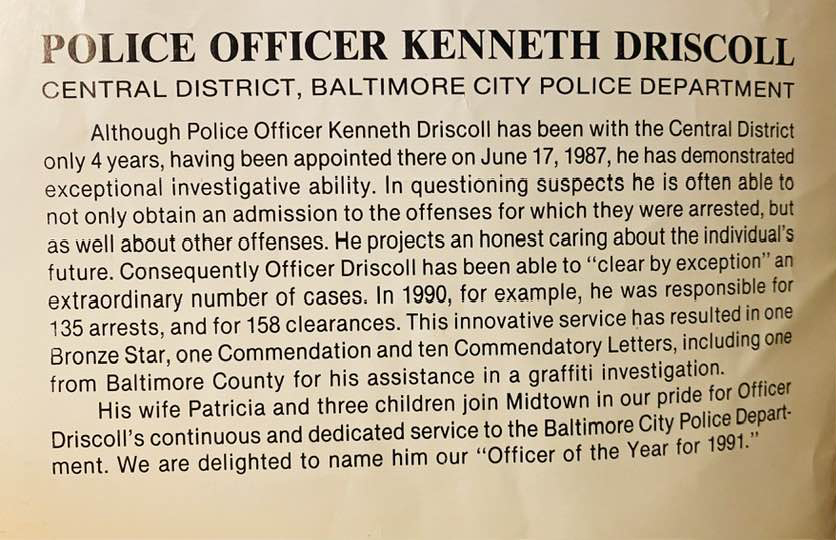 Ken's 1st Officer of the Year


This was a fascinating event as every officer in the room received an “Officer of the Year” trophy, while two officers from the group were singled out and presented with a larger version along with a check. Ken inquired with the coordinator about whether these trophies were kept or discarded afterwards. He was informed that every officer in the room was the “Officer of the Year” for their respective agency, district, or unit, and the two who were called forward were recognized as the “Outstanding Officer of the Year”. This was a moment of pride for every officer in the room, having been selected as the Sun papers’ Officer of the Year for their district, unit, etc. The coordinator explained that they receive hundreds of applications and narrow them down to those who were invited to the dinner.


 6th Officer of the Year
1993 Oh Christmas Tree --
On a frigid, snowy Christmas Eve, Ken and his partner John Calpin were working the midnight shift. It was after 2 am. The night was quiet, the streets were being blanketed by a fresh layer of snow, and they were deserted with the exception of a figure about a block and a half away from the two officers. It was a man hastily dragging a small Christmas tree, its stump freshly cut from the frozen ground.
Ken and his partner started walking towards the man. As they approached, the man looked up. He was known to both officers as a bit of a smart aleck, often giving the police a hard time. He could be described as a career criminal, but his crimes were more low-level nuisance crimes. He was startled when Ken and John walked up on him as he was in the act of stealing a tree that he had just cut down. He began to try to explain his actions. This man, who is normally quite sarcastic with a disdain for local police, was now practically begging not to be arrested by them. He was admitting to having just cut down the tree from the park, an act that was indeed an arrestable offense, and he knew it.
The partners were known for their arrests and could have easily arrested the man and submitted the tree to the Evidence Control Unit (ECU). But they realized that doing so wouldn’t undo the damage the man had already created. The tree wouldn’t magically replant itself, and it would essentially have been cut down for nothing. Moreover, the man’s children would not only have been left without a Christmas tree in the morning, but their father would also be in lock-up instead of home where he belonged.
After a moment of silent deliberation, Ken and his partner made their decision. “We can’t ignore what you’ve done,” Ken said, his voice stern yet sympathetic. “But we also refuse to ruin Christmas for your kids.” He continued, “Take the tree and get going. And remember, if you put your kids first, you wouldn’t be out here at 2 am stealing a tree for them. Improving your family’s situation begins with your working to become less self-centered and starting to explore more considerate methods in your life.”
The man nodded; gratitude was evident in his eyes. As Ken and his partner walked away, they knew they had made the right choice. Sometimes, the spirit of Christmas was about understanding and compassion, even in the face of father, that just seemed to never get right, no matter how hard he tried.
Retired Detective Badge #550
Ken's badge while he was working CD/MCU/DDU
Central District - Major Crime Unit - District Detective Unit
This is the Badge Ken was carrying when he was paralyzed.

This was in the quartermaster's unit since 20 May 2003
I offered to polish it for Ken, but he said, "it is what it is," and to polish it could ruin it
So we'll leave it alone, Ken has two other #550 Detective badges, the Mini Badge and a Duplicate Issue Badge
As well, I bought him the 4th issue badges with his numbers #3232 Officer and #550 Detective.

Ken was conducting some investigations in the city that extended into the county. He shared the information with a friend who was a new county officer. His friend passed on the information as if he had discovered it himself. This continued until he was summoned to his captain’s office and asked questions he couldn’t answer. At this point, he confessed that he had received the information from Ken. Ken’s friend called him and asked if Ken could meet him at Precinct 12, where he met with the captain and shared all his information. Later, some detectives visited Ken’s house, and with the information he provided, they were able to make several arrests.
A year later, in 1989, Ken received an award along with a commendation ribbon. His Lieutenant presented Ken with the award during roll call in his district. However, there was a minor issue. Ken was young, and before he could return to his seat, the same lieutenant reprimanded Ken over a joke he had played on a fellow officer. This didn’t sit well with the older, veteran officers. They made it clear to the Lieutenant that when rewarding an officer’s good work, he should be allowed to enjoy the moment before being chastised over trivial matters. A few weeks later, the same lieutenant called Ken up in roll call and presented him with a city ribbon for the work he had done to enhance the department’s reputation by collaborating with the county police while off duty.
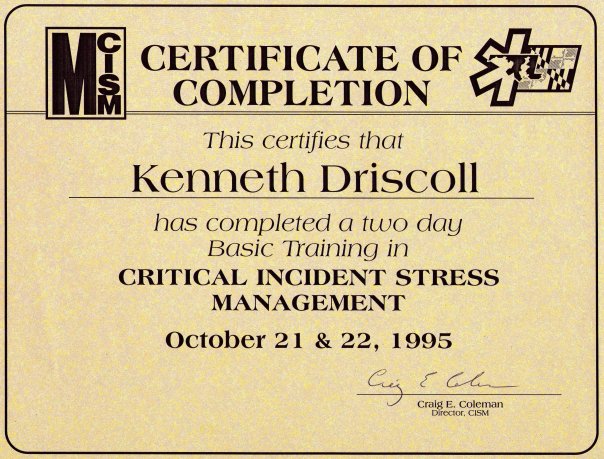
1995 - Ken joined the CISD training team following his second shooting incident. A member of the same team had approached him, suggesting that he would experience nightmares and feel terrible for having shot and nearly killed a man. However, Ken felt quite the opposite—he felt great. This prompted him to consult a doctor, questioning why he felt good when he was expected to feel bad.
The doctor asked Ken why he felt positive about the shooting. Ken explained that it was because he had prevented the man from shooting his partner, the hostage was injured, but the suspect survived. The doctor reassured Ken that his feelings were perfectly healthy, as long as they were for the reasons mentioned and not because he was keeping score, enjoying the smell of blood, the sound of a man crying, or any one of a million other odd reasons one could react to a shooting.
Ken’s reaction was normal. It’s okay to feel proud of saving a friend. Ken felt so strongly about the misinformation and the potential damage it could have caused that he decided to join the team. I remember him coming home from the interview. They had asked a question that he initially got wrong, but when he explained his answer, they re-evaluated the possible answers and Ken was accepted into the group.
The question was, “If you are debriefing an officer that has just been involved in a shooting and he opens up to you, and as the officer talks more, he starts bringing up emotions within you, what do you do?” Ken said he would finish the interview, then seek another member of the group to talk about the feelings he might be having. The correct answer was that he should excuse himself and send in another member of the team.
Ken expressed that personally, he would prefer to finish the session and seek help if he needs it. He would hate to be in the middle of talking to someone who just shot someone, someone who is terrified they might lose their job, someone who doesn’t know if they were right or wrong, and someone who is second-guessing themselves. They start to talk to the guy who came to listen and to help, all the while wondering if they will be okay. Then, out of the blue, the officer who came to help was sickened by what he or she was hearing about what they had done. Ken said he refused to walk out on a fellow officer who needed his help. He would help them no matter how long they needed him, and when he finished helping them, he would seek counseling on his own for his problems.


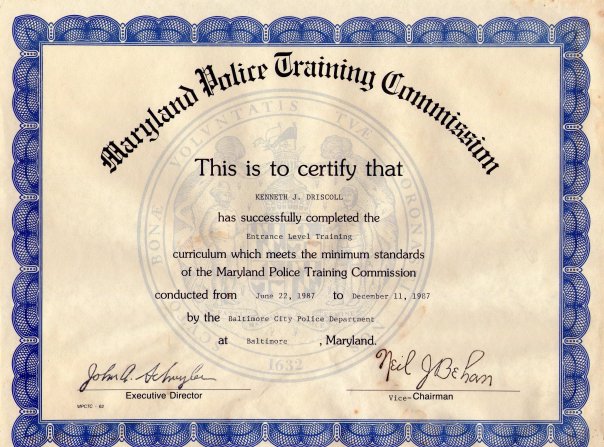
Before completing the auxiliary course, Ken was hired by the Baltimore City Police. He expressed to the city recruiter that he didn’t like leaving things unfinished and asked if he could complete the auxiliary training. His request was granted, and he even assisted on a few cases, such as the Amtrak train crash and a few buy-bust operations.
If you look at the dates, you’ll see that Ken’s Entry On Duty (EOD) was on June 17, 1987, and he finished his training on June 20, 1987. Interestingly, they took his Auxiliary ID when he was hired by the City, and he used his City ID card to attend training and several cases.





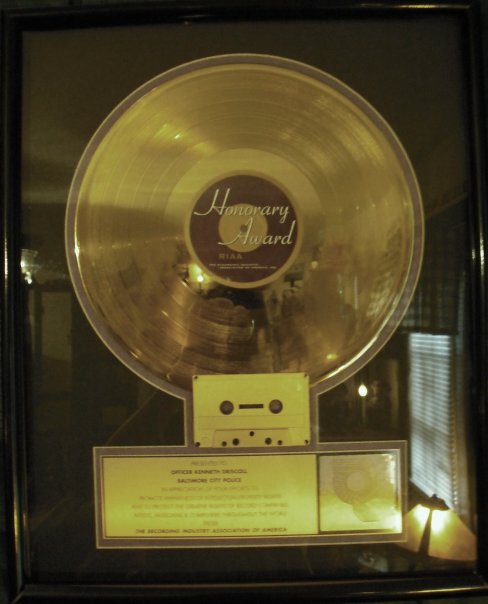

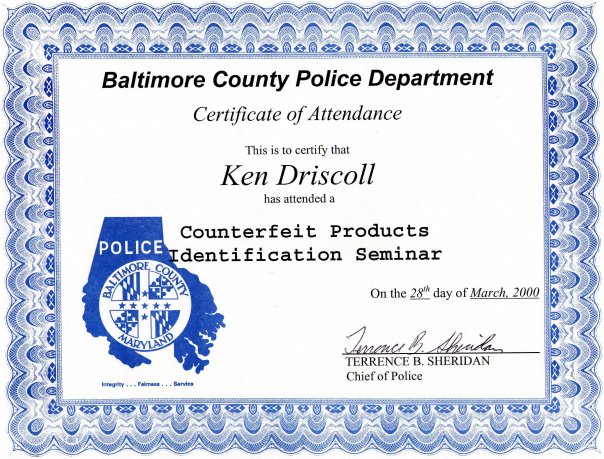
This one was awarded in 2000 and has his actual 1997 bicentennial badge in it


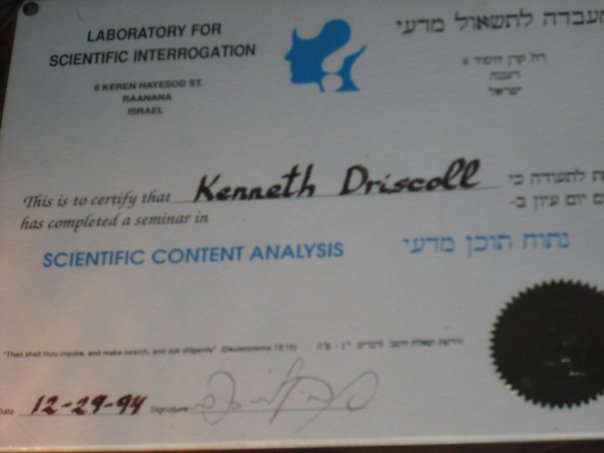
There is a saying, “It is just as important to exonerate the innocent, as it is to convict the guilty!” This resonated with Ken as he studied this technique during his recovery from a shoulder surgery that involved the removal of a large portion of his clavicle and a rotator cuff surgery. So when he returned to work on light duty, he enthusiastically shared with his friends about this new technique he had learned. Most felt it was a hoax, with some of his later Major Crime Unit members dubbing it witchcraft, chicken bones, or a SCAM, a play on the technique’s correct name, SCAN, an acronym for Scientific Content Analysis.
However, it was neither luck nor scam that on the first time Ken applied the technique after more than a year of study and testing, he couldn’t find deception in the suspect's carjacking written statement. The victim called in the report, and within 45 minutes, the suspect was found driving the car. Ken was stumped and ready to call his instructor. It was 3 am, just as he was about to dial the last number, he realized that in all of his training, they never studied from a truthful statement. Ken picked up the phone and called the reporting person in to give a written statement. As Ken tells it, while sitting across the table from the reporting person, the guy furnished writing, and before Ken could turn that paper 180 degrees for him to read it, he had found more than a few red flags. Once Ken was able to read it in its entirety, he knew he had a false report and needed to get the suspect that had been arrested out of lock-up and on his way. This was on a Tuesday or Wednesday night, and by that Friday he was told not to come in on the weekend as he was scheduled to do, but that instead, he was to report to Major Crimes the following Monday as he had been transferred to the district’s investigative unit.


Governor's Citation

Detective Kenneth Driscoll
A Small Sample of Commendatory Letters Ken Received
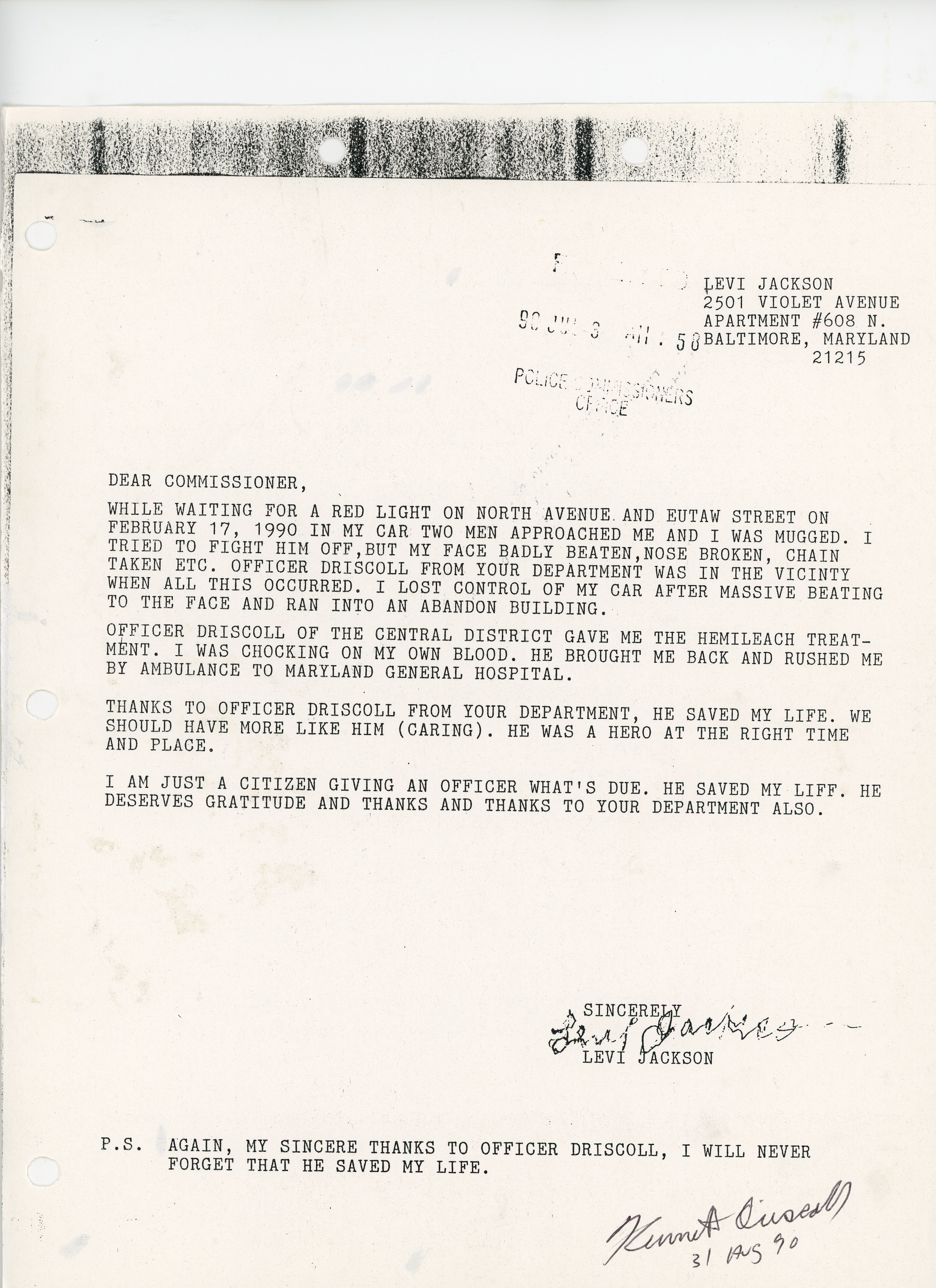 1990 - After writing a letter directly to the Commissioner, Ken was awarded a Bronze Star. Mr. Jackson, the man whose life Ken had saved, came to pin it on Ken’s uniform. After escorting Mr. Jackson to the hospital, Ken returned to the scene of the carjacking to write the report. During this time, a call came in about a hit-and-run accident involving a pedestrian.
Responding to the call, which was within his sight line of where he was writing the report. Immediately Ken recognized that the victim of the hit-and-run bore a striking resemblance to the description given of the carjacking suspect. Ken transported this victim to the same emergency room where he had taken the carjacking victim. This was the first of many times, Ken would arrange a vicitm to see a potential suspect, without saying a word to the vicitm, and just listening for a reaction, if one was given. In this case, as he and the victim of the hit-and-run passed the carjacking victim in the ER, the victim shouted out, “That’s the man who robbed me!” With that, Ken arrested the suspect on the spot, effectively closing the case.
A search incident to the arrest revealed the victim’s necklace in the suspect’s pocket. The suspect was subsequently sentenced to 10 years for the robbery.
 1991 - As Ken was beginning his shift and heading up the Jones Falls Expressway, he noticed he was trailing behind a man who began swerving from lane 3 to lane 1 and back to lane 3 again. The man was using both shoulders’ (Jersey walls) as runners, running his car up onto those barriers. At one point, he even drove up and partially over one of the barriers. Fortunately, he landed on the side of the road he was on, and his car stalled. Ken approached, thinking the man had suffered a heart attack, and began administering CPR - specifically, chest compressions. The man regained partial consciousness before passing out again. By now, the medics had arrived, and they too began CPR by giving chest compressions before taking him to Shock Trauma. The doctors later informed the accident victim that it wasn’t a heart attack, it was heart-related, and the actions of providing chest compression by both Ken and the medic had indeed saved the man's life. In gratitude, the man wrote a letter to Ken’s sergeant.
 1994 S.C.A.N. Letter
1996 - This letter is one of many, but one that has meaning to Ken, He admired these two detectives (Det Mike Wilhelm and Det Gordon Carew) for giving credit where credit was due. He was also asked many times to leave Central District’s Major Crimes to go to CIB Robbery and other CIB units, but Ken felt he belonged where he was and appreciated their giving him a chance, not just with the new SCAN Technique, which, when Ken first introduced it, was not well received. There was a Sergeant, either Sgt. Winter, or Sgt. Summer, Ken would know, but that Sergeant did not like the idea of someone being able to find deception without some kind of machine, and for that, he did not like Ken.
Ken was trained by Avinoam Sapir, who, after Ken discovered several linguistic traits that held significant meaning and helped solve cases, dubbed Ken a “Guru” on the subject. Sgt. Dull observed that the student was becoming the teacher. Ken devoted himself to studying the technique at every opportunity, whether at work during a slow day, at home, or on vacation. He would practice whenever he could.
Ken often likened handling a statement to managing a crime scene, emphasizing the importance of preventing anyone from contaminating their statement or crime scene. He and others trained in the technique could identify when a subject was told what to say or was using words they had picked up from an investigator. They could also discern if it was the first time they had given the statement or if it had been previously given to the police. The accuracy of the technique was often startling.
Initially, I only saw Ken applying it, but over the years, I saw him train others. They would share statements in practice, consistently arriving at the same observations. I found it fascinating to see Ken work cases on the news and share his findings with other agencies. Some accepted and utilized his insights, while others dismissed him less graciously, only to later realize the accuracy of the technique.
Ken’s unit in the Central District transitioned from a District Major Crime Unit (MCU) to a District Detective Unit/Major Crime Unit (DDU/MCU) in late 1999 or early 2000. At that time, all members of the unit received the new title of detective. Ken transitioned from police officer badge number 3232 to detective badge number 550.
They didn’t officially hold the title detective for the first seven or eight years they worked together, but they held some of the best closure ratings in the city as they did their plain clothes investigations. The reason behind it was a rotation policy; detectives were rotated to patrol after three years. District Majors realized their detectives were learning and getting better; after three years, they were either very good at what they did, or they were not, but to bounce them from investigations should have been based on ability, not longevity. Investigators came and went, but the best of the best was held on to, not rotated back to patrol. Don’t get me wrong, patrol is not beneath an investigator; Ken loved it and would have done either with pride. But like anything, some people are better at one thing than another, Some guys loved patrol and hated investigations; letting officers do what they do best was the best way to run an agency, but we had a commissioner come in who felt rotation was the best policy. It cost us some of the best detectives in the country, as these men and women left the agency to work for departments with better sense.
Ken often compared handling a statement to managing a crime scene, emphasizing the importance of preventing anyone from contaminating their statement or crime scene. He and others trained in the technique could identify when a subject was told what to say or was using words they had picked up from an investigator. They could also discern if it was the first time they had given the statement or if it had been previously given to the police. The accuracy of the technique was often startling.
Initially, I only saw Ken applying it, but over the years, I saw him train others. They would share statements to practice, consistently arriving at the same observations. I found it fascinating to see Ken work cases on the news and share his findings with other agencies. Some accepted and utilized his insights, while others dismissed him less graciously, only to later realize the accuracy of the technique.
Ken’s unit in the Central District transitioned from a District Major Crime Unit (MCU) to a District Detective Unit/Major Crime Unit (DDU/MCU) in late 1999 or early 2000. At that time, all members of the unit received the new titles of detective. Ken transitioned from police officer badge number 3232 to Detective badge number 550. They didn’t officially hold the title of detective for the first eight years they worked together, but they held some of the best closure ratings in the city, as did their plain clothes investigations. The reason behind it was a rotation policy; detectives were rotated to patrol after three years. District Majors realized their detectives were learning and getting better; after three years, they were either very good at what they did or they were not, but to bounce them from investigations should have been based on ability, not longevity. Investigators came and went, but the best of the best was held on to, not rotated back to patrol. Don’t get me wrong, patrol is not beneath an investigator; Ken loved it and would have done either with pride. But like anything, some people are better at one thing than another, Some guys loved patrol and hated investigations; letting officers do what they do best was the best way to run an agency, but we had a commissioner come in who felt rotation was the best policy. It cost us some of the best detectives in the country, as these men and women left the agency to work for departments with better sense.
LSI stands for Laboratory of Scientific Investigation.
S.C.A.N. stands for Statement Content ANalysis
The F.A.S.T. macro stands for Forensic Analysis Software for Theirwords
 1995 - A professor stole a student’s credit card, and Ken was assigned to the case. Knowing that if the media caught wind of the situation, it could spark a scandal that would overshadow the school and the case, Ken handled the matter with discretion. He filed charges against the professor and managed to rectify the student’s credit card charges, ensuring any associated fees were waived or dropped.
The case was quite compelling. From what I remember, the professor was a kleptomaniac who appeared indifferent to the situation, asserting that her husband would take care of everything. She subsequently resigned from her position at the school. I suspect she may have perpetuated her pattern of theft at other educational institutions, just as she had in Baltimore and at other schools where she had previously been employed
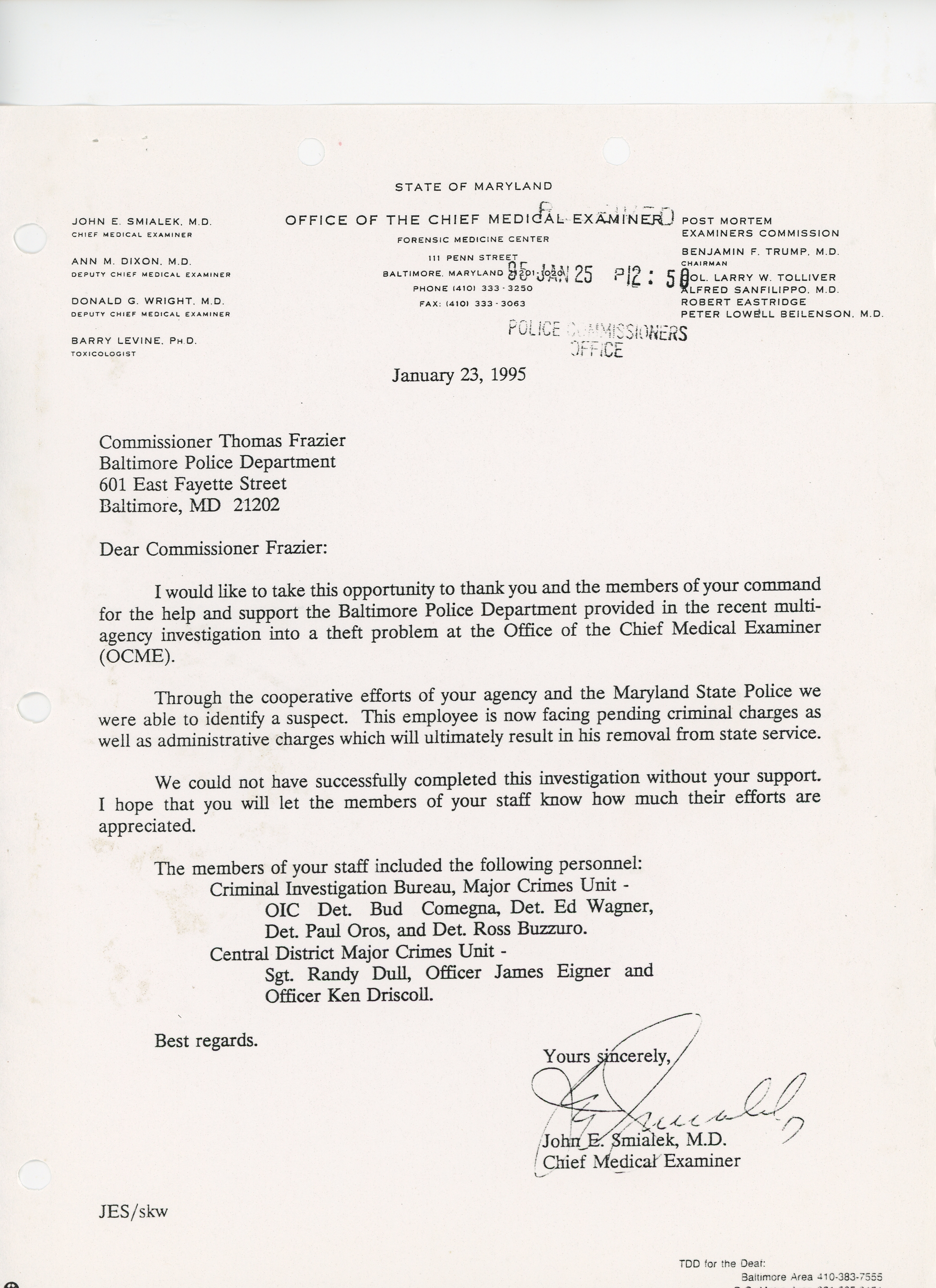 1995 - Ken devised a plan to catch a thief by placing a fake Rolex watch in a safe at the Baltimore City Morgue. The watch was listed as property belonging to a John Doe, whose body had been sent to the medical school for student study. A camera, borrowed from the Maryland State Police, was positioned above the safe that held Ken’s watch. After two weeks, the suspect was caught on camera stealing the watch.
Interestingly, Ken had already identified him as the main suspect based on a SCAN Questionnaire. When another theft occurred a year or so later, Ken distributed the same SCAN Questionnaires. Most of the employees remembered the questionnaire from the previous incident, which resulted in one of the employees quitting, stating he refused to fill out the questionnaire. Coincidentally, he was their main suspect.
Ken was fortunate to work with a supportive squad, as he often came up with unconventional strategies, and they always backed him up. This was just one of those instances. The TV show “Homicide Life on the Streets” picked up on this and featured a similar story where a crime took place in the Baltimore City Morgue.
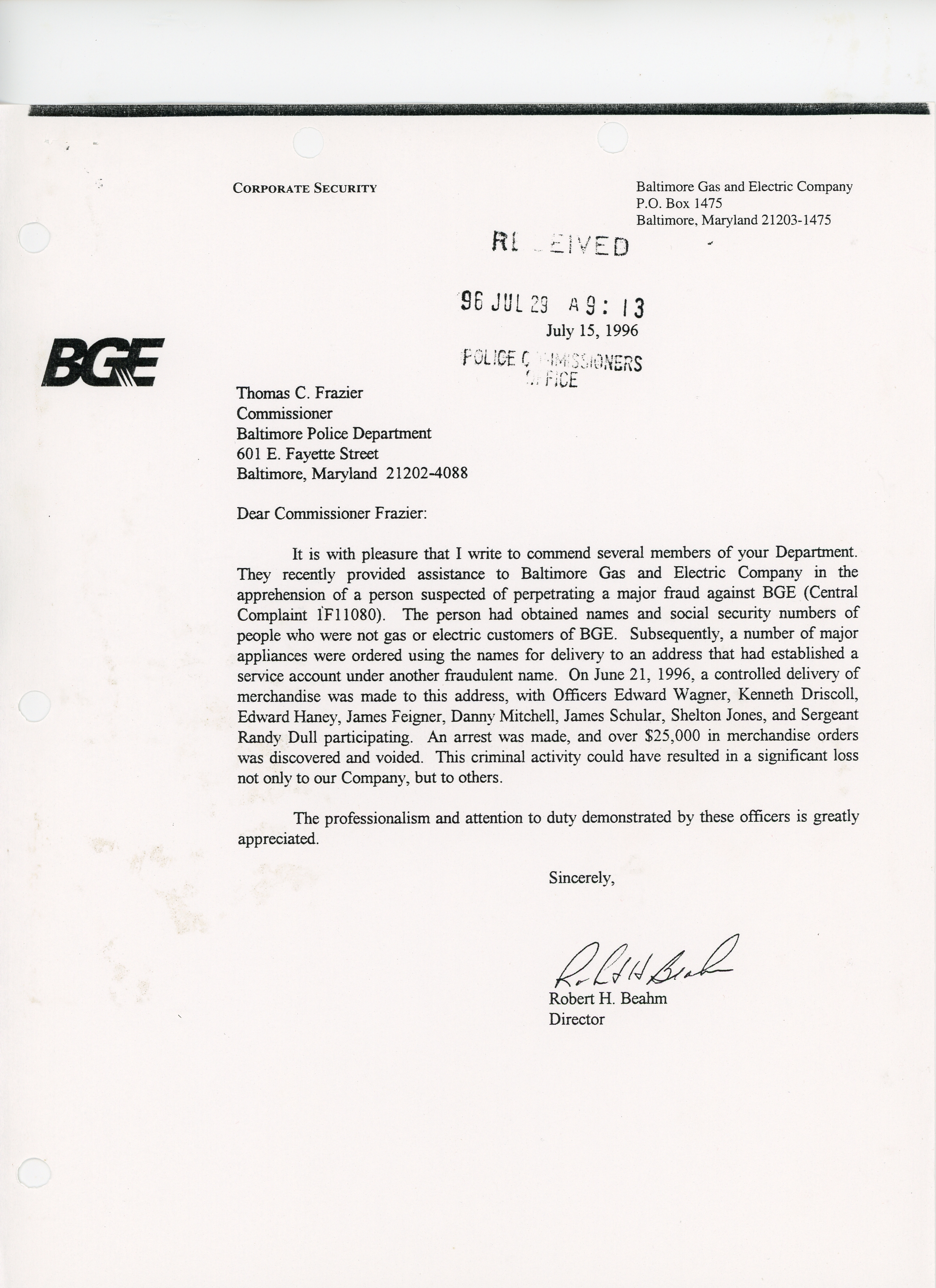 1996 - In Ken’s unit, they primarily conducted investigative and interview, interrogation type work. However, on occasion, they would engage in undercover operations. I vividly recall them often dressing as delivery men, impersonating everything from pizza delivery to bicycle courier services. Ken had an array of uniforms, including an inspector’s (used for lead paint checks), and he, along with his various partners, relished these plain-clothes exercises.
On one such occasion, Ken was paired with one of his favorite undercover police partners, Ret. Det. Ed Chaney. The duo dressed as BG&E delivery men, with one posing as a trainee. This provided a plausible reason for having three men on the truck. Although BG&E trusted the partners with their uniforms, they were less trusting when it came to allowing either officer to drive their truck. They were tasked with delivering a range, a range grill, and a third item, which Ken has forgotten.
The recipient resided on the outskirts of Bolton Hill, around the 1400 - 1500 block of Mt. Royal Terrace. She was a cleaning lady who had been stealing people’s identities from papers she found in trash cans at her night job. She would then establish credit accounts and place orders through BG&E for various items using the stolen identities. She had people from her family, neighborhood, church groups, etc., all placing orders for everything from living room sets to refrigerators, dishwashers, and microwave ovens. The lady would place orders under the stolen names, costing her nothing, and then sell the items for three-quarters to half their listed cost, making a significant profit.
After she signed Ken’s clipboard using the false name, let’s say it was “Rose”, Ken double-checked the signature to ensure she had signed under the false name and not her actual name, “Betty”. He also wanted to make sure her signature was legible. Ken was concerned that if she signed as sloppy as he does; he might interpret it as “Rose”, but she could claim it says “Betty”, making it unclear whether it was her alias for the day, or her actual name.
Once he confirmed that the signature matched the name on the order and couldn’t be confused for anything else, he called her by the name from her stolen identity. He did this twice, first asking “Rose, where do you want the range? He yelled down to get Ed’s attention, then turned back to her and again used her name, “Is it okay here, Rose?” Each time, she responded. He then began giving directions to his crew. Ken was acting like one of those guys who uses names a lot. “Ed, can you get the items off the truck and bring the stove vent up? Have Bob stay down there for now and watch everything. You got that, Ed? Bob, can you hear me? Good, Bob, make sure you can keep an eye on the truck and the three pieces we’re dropping off. Also, Ed, bring the vent up for me.”
Once he established that he is one of those guys who uses a person’s name to the point of being excessive, and he put a bit of what is known as timed misdirection from when he was calling her by name to start, he turned back to her and called her by her real name, “Ms. Betty, do you want the range left in the hall downstairs?” When she said yes, he yelled, “Ed, leave the range in the hall. Don’t bring anything up yet. Oh, and Ed, have Bob help move things around in the truck for our next stop.” Turning back to Ms. Betty, he says, “You say this is only until you get this one out. That makes sense. I may have to explain to my boss: Can I use your phone, Ms. Betty?” Keep in mind, he didn’t have to do this, but he did it twice, calling her by her real name, just for fun, and each time she responded. Had she caught on, he would have identified himself sooner. She had already responded to the false name and signed the false name, so he had her, but he liked to have a little extra icing on his cake, with her now answering to her actual name, he had a nice bit of extra info for the statement of probable causes.
Now, as his search team was arriving, he identified himself and Ed as Baltimore detectives. The thing was, they did not have a search warrant for her apartment yet, so the search team stayed behind to secure the apartment, while Ken and Ed went to write a search warrant, took it to a judge, and had it signed. Normally, they would radio to the team and tell them to proceed with the search, all they need is knowledge that the warrant exists. But the courthouse was about a mile from the apartment, so they just drove to the apartment.
As they approached the top of the steps, their sergeant asked if they got the warrant. Ed closed the door and said, “We got the warrant, everyone stay back. Ken got a no-knock warrant, and we’re kicking this door off its hinges!” Of course, he was joking. While they were gone, his sergeant and the search team had begun talking with Ms. Betty, and kept things civil, so when Ed did the no knock joke she laughed, she now knew Ken and Ed had the same sense of humor as the rest of the team. They got all the evidence and paperwork they had come for, linking her to dozens of other thefts of customers’ identities and built a strong case before arresting her that night.
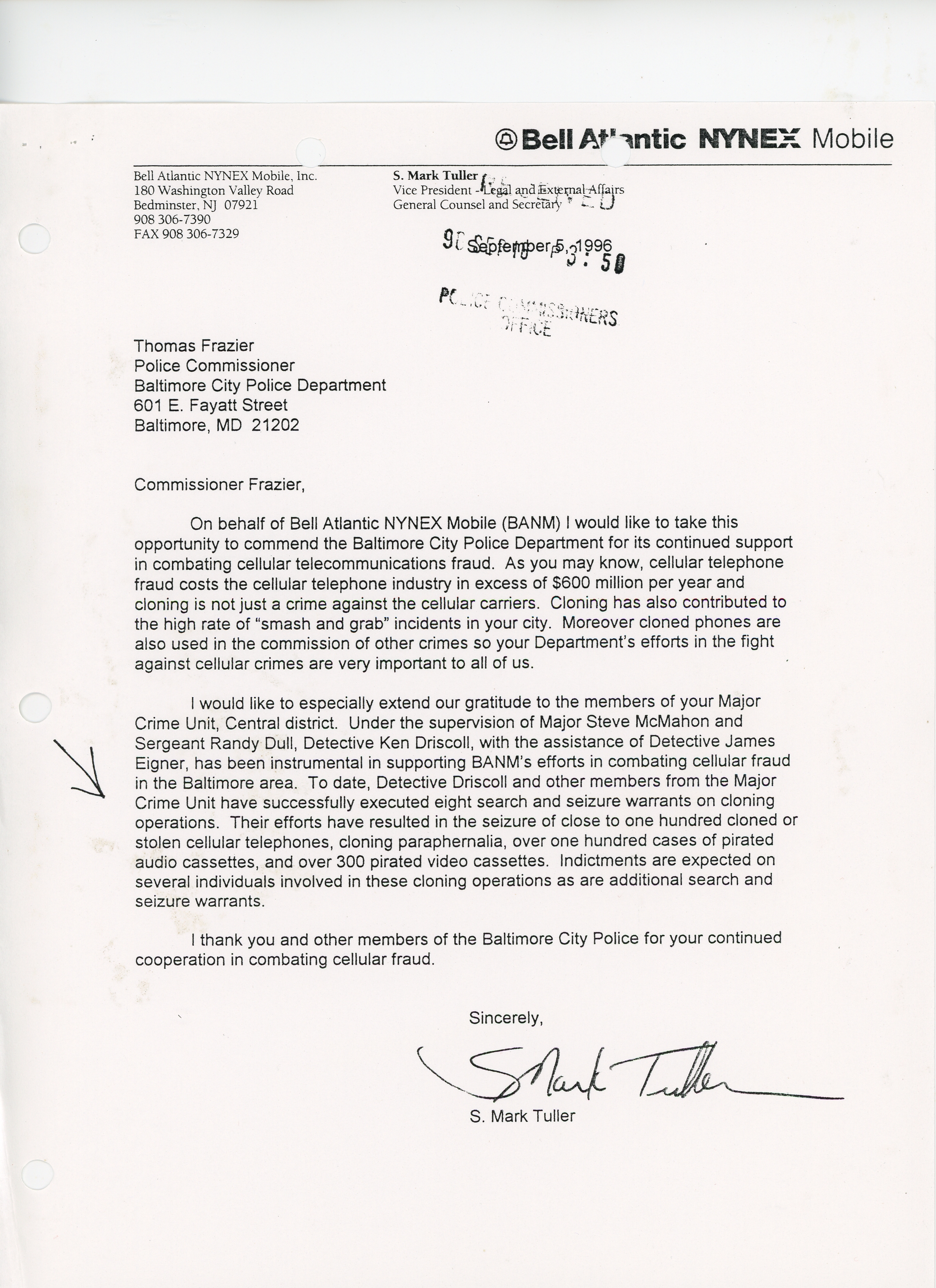 1996 - Regarding the Bell Atlantic Cloned Phone Case
In the early era of cloned phones, Baltimore’s law enforcement was faced with an interesting trend. A sudden increase in stolen cell phones was observed around the Inner Harbor, with robberies occurring near North Ave. and around Pennsylvania Ave. in which phones were also being taken. Given that a stolen phone was generally considered to have no monetary value at the time, this spike was perplexing.
Ken noticed this anomaly and brought it to the attention of his Sergeant (Sgt Randy Dull). After discussing it with the Major (Steve McMahon), Ken was given the green light to investigate. He reached out to the two dominant phone companies at the time, Bell Atlantic and Cell One. Both companies were eager to collaborate and shed light on the situation. They revealed that smaller companies were cloning the stolen phones and selling them for as much as $125 a month, offering the buyer 30 days of unlimited access. These shops couldn’t keep the phones on their shelves, explaining why they were buying so many stolen phones and why the spike in these thefts became noticeable.
News of this investigation spread quickly, leading to the formation of a task force that included police from Baltimore City, Baltimore County, the US Secret Service, US Customs, and several private investigative firms. The PI firms were particularly helpful, providing a lot of manpower, which was often needed in the field.
Ken, known for his innovative thinking, realized that he was spending $125 per store to purchase a cloned phone for conducting a search. However, he observed that his informant, while buying cloned phones at these businesses, was also purchasing pirated mix tapes or CDs, all with the same buy money. Seeing an opportunity, Ken proposed a new approach to his supervisor. Instead of purchasing a cloned phone for $125, he suggested buying two pirated CDs and a bootleg mix tape for just $25. This alternative approach would still provide the same probable cause to conduct a search and seizure warrant, but at a significantly reduced cost.
Ken explained that for the same $125, he could gain probable cause to raid one store by buying a cloned phone, or he could hit five stores if he bought pirate CDs and a bootleg mix tape instead. He had 13 stores in his sights, all selling phones and pirate music. So, he could spend $1625.00 and buy 13 phones, or he could hit the same stores for $325.00. His supervisors agreed to this approach, appreciating the cost-saving aspect.
Ken contacted the RIAA (Recording Industry Association of America) and invited them to join the task force. With the RIAA on board, it not only gave them more ammunition as far as probable cause, but it also gave them more training, so they would know what laws were being broken and how to charge properly. Along with this training, came buy money and more manpower. Elevating this task force into a new league.
There was a kind of, you scratch my back, I’ll scratch yours when it came to working with the RIAA, as there were some businesses, in Baltimore that were not only selling pirate bootleg music but were also manufacturing it. So, from time to time, Ken’s team hit stores solely for bootleg pirate music. But it all worked out as they seized millions in illegal recordings and recording equipment.
The investigation continued for around two years. When it started, cell phone companies were losing millions every year. By the time the task force completed their investigations, losses were down to around $10K a month, a figure the phone companies found acceptable and less than they were spending to combat it.
This case serves as a testament to the collaborative efforts of the police force and their pioneering strategies in addressing intricate issues. It underscores the pivotal role played by each member of the team, including Ken, his sergeant, his major, and notably, his squad and the task force they assembled. Their collective efforts were instrumental in mitigating crime and enhancing the safety of the community. Their dedication and commitment serve as a model for effective law enforcement.
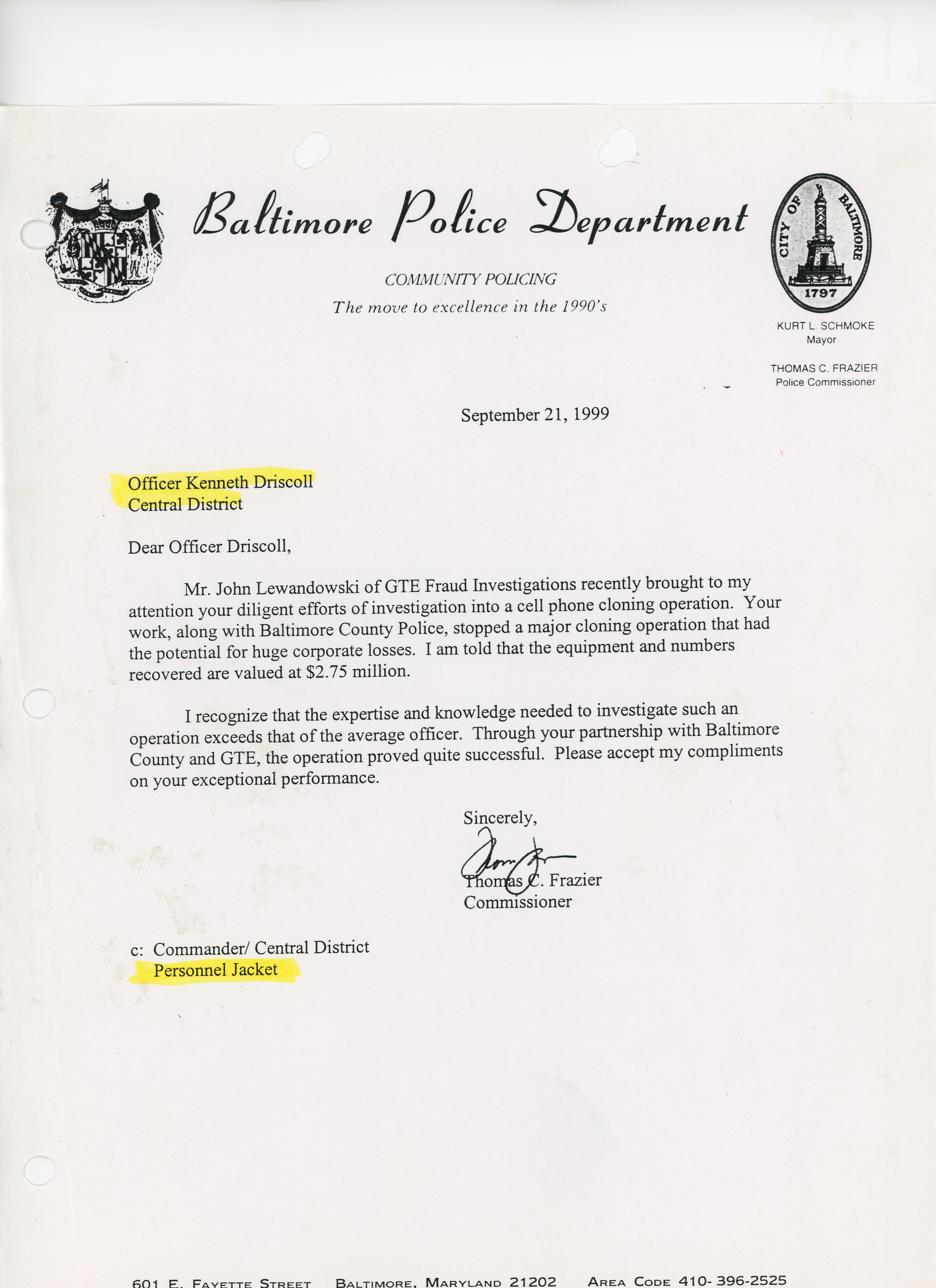 1999 - This $2.75 Million Dollar Cloned Phone Case is another example from the cloned phone cases mentioned above that Ken worked on.
Ken reached out to the carriers and connected with the loss prevention departments at both Bell Atlantic and Cellular-One. Both companies were eager for Ken’s assistance. They explained the intricacies of the cloned phone industry and provided guidance on how to best investigate such cases.
In addition to their insights, they also supplied private investigators to bolster manpower for the investigation. They went above and beyond to ensure Ken had whatever he needed to conduct a thorough investigation.
- EOD 17 June 1987
- RFD 29 May 2003
Badge Numbers -
- Officer #3232 and
- Detective #550
- 3 Bronze Stars
- 3 Unit Citations
- 2 Commendation Ribbons
- 2 Citations of Valor
- Over 100 Letters of Commendation
- 7 Officer of the Year Awards
- A Purple Heart & Legion of Merit (Police Hall of Fame)
- A Distinguished Service Award (Police Hall of Fame)
- A Mayor’s Citation
- A Governor’s Citation
- 2 Gold Records from RIAA
- Certificates from the Motion Picture Association,
- Certificate RIAA Recording Industry
- Certificate US Secret Service
- Member of the Police Hall of Fame
- A 15-year Safe Driving Award
- Retired Detective Badge #550
Ken list of Injuries -
- Broken Foot
- Sprained Right Wrist
- Broken Right Wrist
- Sprained Left Wrist
- Second Break to Right Wrist
- Broken/Separated Right Shoulder/Clavicle
- Broken Finger
- Fractured Vertebra leading to Paralysis
- Hairline Fracture to his Femoral Neck
- Hairline Fracture to his Skull
- Puncture Wound on the right side of the Stomach area
- Stab wound in the Left Arm

The entire process, from inception to completion, took 18 months, and the museum opened its doors on June 26, 2017. The museum showcases a rich history of over 200 years through photos, documents, uniforms, badges, guns, an original 1953 polygraph machine, a district cell block, and other memorabilia.
Visitors can walk into the old cell block, stand in front of a physical lineup, and use their smartphones to access more information by scanning the interactive QR codes set up throughout the museum. The 360-degree QR codes are a unique feature, allowing visitors to virtually pick up various items and view them from all angles using their phones.
The museum is located on the ground floor in the “Gallery” of the Bishop L. Robinson Sr. Police Administration Building at 601 E Fayette St. A picture was taken at the reopening, and the scissors, ribbon, and picture were given to Ken for safekeeping.
Ken says the picture has an error because, due to the angle of the shot, it looks like the commissioner is holding Ken's hand or vice versa, so Ken gets a good laugh but thinks another angel would have been nice. War Story
He Got'em with the Door
Recently, at the same store, Ken assisted in the arrest of a shoplifter who was resisting arrest and fighting with a Baltimore County officer. This officer was working secondary at a Weis Grocery Store. Ken and our son-in-law, Josh, were waiting out front for our daughter.
As our daughter was entering the store, Ken noticed a young man in his late 20’s squeeze out through the indoor. At the same time, another young man exited through the exit in a hurry. Within seconds, the two clashed. The one that came out after him quickly identified himself as a police officer, and a struggle ensued.
The shoplifter pulled away and ran westbound up the parking lot, away from the store. For some reason, he then turned around and ran back up the parking lot in an easterly direction. As he was about to pass in front of Ken and Josh, a second security officer came out of the store and identified herself. The suspect turned to run between the cars, now heading in a southbound direction away from the store and up the aisle on Josh’s side of the truck.
With a row of cars in front of them, there was still time for God to answer Ken’s prayers, and He did. The suspect turned between the car in front of them to run east again, and then as he passed that one car, he made Ken’s day by turning to his right, now heading south again, and about to pass Ken’s door.
Ken said he had a million things running through his head. To put the window down and reach out would potentially damage the car/truck if he were to struggle against the paint. If he were to open the door too soon, the guy could buckle the door panel. So, he had to wait until the guy was further alongside the truck, so Ken would get him with the back edge of the door, just under the handle and toward the back edge of the door.
So, Ken waited until he felt it was right, and then quickly opened the door. This action slammed the suspect into his right side, knocking him off balance and into the car parked next to them. This also made him drop the items he had stolen and kept him stumbling to regain balance long enough to allow the police officers chasing him time to catch up.
He was cuffed and marched back into the store, where he was processed before being taken to booking.

Retired Detective Ken Driscoll's
War Story
Wheelchair OC
Several years ago, after Ken had sustained an injury, we found ourselves in a Walmart in Ocean City. From his position in a store’s power chair, Ken overheard an argument. Two men were engaged in a heated dispute. Ken maneuvered his way to the arguing pair and positioned himself right between them. He urged them both to calm down and listen.
Ken pointed out that one of the men had been drinking. When the man started yelling at Ken, Ken responded, “Hold on and just listen. I’m not passing judgment. I’m just trying to say, this is not the place. The police are on their way, and when they get here, they won’t care about your story. They will just take you in.”
Both men listened. Ken then offered some friendly advice. “If I were you,” he said, “I would separate in different directions and take this up sometime later. You, when you have not been drinking, and you, when you have had more time to think out your argument. Now let’s separate before the police get here and someone ends up in jail.”
The two men left. Len noticed three guys standing by, all wearing khaki pants and black golf shirts. One of them approached Ken and asked where he was a police officer. Ken told him he was with the Baltimore Police, and they reacted as if they had met a rock star. Baltimore police are highly respected in the police community.
Ken was using words to calm the two guys—words that subconsciously partnered the men up with him and didn’t make it seem like he had taken sides or that it was him against them. He used words like “we”, “let’s”, and “they”. He wanted to make it seem like a partnership, so he used “we” and “us”, “let’s” which is short for “let us”, and “they” to refer to the police. So now the suspects saw Ken as one of them and the police as the “they” that was not Ken or either of the suspects. He also limited their time to think because “they are on their way”.
The guys in khakis were security and let Ken run the show because it was working. The main security guard said he didn’t want to interfere with what was obviously working because it would have just started things over. They thanked Ken for solving a problem.
The point is, with the right words and the right attitude, even heated, angry drunks can be calmed down. It also goes to show that Baltimore Police are Baltimore Police for the rest of their lives. They never stop caring, and their training doesn’t go away
War Stories
Winner Winner
When Ken was in Major Crimes, they had a few warrants they wanted to serve. Borrowing from the old baseball ticket raffle winner ruse to trick wanted persons into coming to the police, they sent out letters stating that during their last arrest, money and/or property were not picked up. If not picked up by a certain date and time, the money/property would be forfeited to the police.
Some people, even knowing they had no money at the time of their arrest, couldn’t resist a chance to get something, even if they knew it wasn’t theirs. So, out of 30 letters, 15 wanted people came in to claim their property/money and were arrested. After that, they simply sent letters stating that the person was wanted. With that, they had about the same response of 50/50 turning themselves in or continuing to run.
One individual actually sent a letter back saying, “F-you, catch me if you can!” When he was later caught, he told the officers who sent the letter that he didn’t write that response; his sister did. These types of schemes were common in these type units.
One scheme I remember Ken talking about involved a suspect’s phone number. They had the number but didn’t have his address, and it wasn’t in the criss/cross. So, Ken called the number and told the person on the other end of the line that he was with BG&E. He said they had a guy on the pole out front of the person’s house who wasn’t answering his radio and that his wife was going into labor. If they would go out front and tell him to call the office, and he did, they would give them half off on their BG&E bill.
The person was excited, put the phone down, and went out front. A short time later, they came back and said no one was on the pole. Ken asked if they were sure and if they saw his truck. They said they did not. Ken asked, “This is 602 W Lanvale?” The caller said no; this was 2238 Callow Ave. Ken said, “Well, that explains why he is not out front. Okay, well thank you anyway, and don’t worry, we’ll make sure you get your discount. Is there an apartment number or is it a whole house?” They told him it was a whole house, and with that, they knew where to get their suspect.
The tricks they used were sometimes things you would think you would only see in movies, like wearing delivery man uniforms and delivering packages, then arresting the suspect that signed for the package. Dress-ups were a norm for these guys, thinking fast to almost con a suspect into a confession.
Speaking of cons, Ken once had a Flim-Flam artist act out his game to pull someone in on a pigeon drop. After doing so, he told Ken’s sergeant, “Ken was good, and the department was lucky he was on their side, because if he was in the game, he would be one of the best, as he just conned a con into allowing him to be filmed acting out the game.” Something he said he had no idea he would ever do, but Ken made him feel like it was all his choice and that is the main rule in a con, having the stooge think they are in control. I will have to con Ken into telling me more of his stories.
War Story
Tech 9 - 22

As a rookie police officer, Ken was assigned to Central District’s Sector 3 in car 136, which covered Reservoir Hill at the time. This was back in the late 1980s when Whitelock and Brookfield were hotspots for crime, including drug dealing, gunfights, murder, burglary, theft, and more.
One night on a midnight shift, Ken received a call for a purse-snatching. En route to the call, he spotted a suspect carrying a purse and matching the description given by KGA. Ken stopped the suspect and requested that someone pick up the victim and drive her past his location where he had the suspect and two or three volunteers standing around his car. As she was driven by, she identified the suspect Ken had stopped as the person who had knocked her down and taken her purse. She also described her purse, which not only matched the purse the suspect was carrying, but her identification was still inside. The suspect was taken to men’s detention, which at the time was still in Central Police Station.
While filling out the charging papers, which were handwritten since this was before computers, the suspect had to use the bathroom. This required Ken to take off his gun and put it in the drawer next to the Desk Sergeant. The suspect had been drinking and had to relieve himself a few times, each time requiring Ken to secure his gun next to the Desk Sergeant. He also had drugs in his pocket. Ken didn’t bother to charge him with the drugs, but he still had to submit them. By the time he was wrapping things up, it was nearing 2:00 am and Ken was on his way through the garage toward men’s detention to take the reports down to his Sergeant.
Officer Dave Robertson stopped a car in the 1600 block of Pennsylvania Ave. No one called to back him up, so Ken, who was walking past his car on Frederick St. at the time, hopped in and took off from the headquarters building, and up the Jones Falls. Before long, he was pulling up on Dave. You would have to know Dave to understand why someone would drive like a nut cutting across one-way streets, hopping curbs, etc. Dave fell into more trouble (as Ken puts it) than the guy that empties outhouses at a state fair. Plus, Ken had a weird feeling just from the tone in Dave’s voice. Police tend to hear changes in the voice of their squad members and know when something isn’t right.
So, Ken pulled past the stopped car and backed up on its front bumper, got out, and walked past the car to meet Dave at the back, driver side bumper of the suspect vehicle. On the way by, Ken recognized the driver, whose last name was Smith. It has been nearly 30 years, so neither Ken nor I can remember his first name, but I know Ken arrested him for drug dealing in the past. He had told me how when Smith was clean, he was sarcastic and just the type you wished you could knock on his butt, but Ken respected the job and his family too much to throw it all away over his ego. So, Ken would just wait until the next time. Statistically with this suspect, if he was clean today, he would be dirty tomorrow and the rest of the week. Whenever Smith was dirty, he lost his wit. One time Ken asked his name, he told him let’s say, William Smith; Ken asked him to spell it, he spelled his first name fine, but when he got to his last name, he said S – M– I – and froze, he got to the “TH” and stopped. It was no use, he couldn’t sound out the “TH” sound. That time he had a nice little knot of dope and gave Ken a reason to knock him on his bottom. It seemed when he was dirty, he lost his train of thought and grew a set of whatever it was that makes someone think it is a promising idea to fight a police officer that weighed about 225 pounds compared to his 155 pound frame.
By the way, Ken never gave a suspect more than was needed to get them into cuffs. So now Ken was standing with Dave at the rear bumper, Dave tells Ken he thought the driver was drinking because he was driving without headlights. Ken asked if Dave searched the car, gave Smith a roadside sobriety test, or if he even knew who Smith was? Dave didn’t… didn’t and didn’t… and to make matters worse, he had lost interest, so he told Ken he was about to just cut them loose and Ken could take over on the case if he wanted. Ken called the driver (Smith) to the back of the car and asked if he could search his car, Smith gets frantic, started to open the hatchback on the car while saying, “I don’t know what you’re looking for, other than the baby I locked in here earlier, but you can…” and before he could say, “search the car!” Ken closed the hatchback and had Dave hold onto Mr Smith. Ken clarified again, it was OK to look in the car, and Smith agreed that he could. But again, he was talking in a nervous way that from experience Ken knew he was dirty, somehow and it seemed he was trying to send a message to the passengers in that car. Ken opened the back passenger side door and pulled the guy from the back seat out as he did he ran his hand around the guy’s waistband and came up with an 8 shot .22 caliber revolver. Ken quickly cuffed him and leaned him in the street, with his knees in the gutter, his feet were crossed and up on the sidewalk, his head leaning on the car and of course his hands were behind his back and in cuffs. Ken had Dave watch of the two prisoners while Ken opened the front passenger door and immediately saw a Tech-9 in plain view sitting on the floor between the suspect’s knees. Simultaneously, Ken pulled the passenger and the Tech-9 out of the car. But unlike the guy in the back seat, when Ken went to cuff this guy he started to put up a little struggle, he wouldn’t say it was a full-fledged fight, but for a split second, it was headed that way and because Ken’s hands were filled with the suspect in one and the suspect’s gun in the other, Ken had little choice other than to put the muzzle of the Tech-9 to the suspect’s temple while ordering him to, “stop resisting”. The suspect said, “OK… OK… I am not going to fight!” he stopped struggling and continued, “it has a hair trigger! be careful!” Seconds later, with everyone secure, and a wagon on its way, Ken called for EVU (Emergency Vehicle Unit) to come clear the weapon. I mean, after all, Ken said it felt as if the slide was stuck and the suspect just told him it had a hair trigger. The last thing Ken wanted to do after making a pretty good arrest was to let a round go off, down Pennsylvania Ave. at 2:30–3 o’clock in the morning.
While Ken was waiting for the Emergency Vehicle Unit (EVU), a man approached him to report that he had just been robbed by the three individuals Ken had arrested. The man explained that he was exiting the Golden Sun carry-out when two of the individuals got out of the car, took his food (a cold cut sub), his Pepsi, a $20 bill, and a gold pinky ring with his initial on it.
Everything the man claimed was taken was indeed recovered in the car. The individual with the 8-shot revolver had a $20 bill, and the individual with the Tech-9 was wearing the pinky ring. The initial on the ring matched that of the victim, not the person wearing it. Furthermore, the victim described the guns used, and at the time, the guns were locked in the trunk of Ken’s car, making it impossible for him to have seen them.
Given these circumstances, Ken was convinced that the man was telling the truth. Not only had he been robbed, but it was indeed done by the three individuals Ken had in his custody.

With the description of a Tech-9 going out over the air, along with a wagon call for three arrests, the curiosity of their squad was AWAKEN and everyone came to have a look see at what these two had gotten themselves into. The first guy on the scene was Officer Kelvin Vincent; Kelvin said, “Good case, Driscoll, two guns, three arrests, a victim reporting he had been robbed by the three a few minutes earlier; good stuff. But I have to ask you; where’s your gun?” Ken looked down on his hip as he reached for an empty holster and sure enough, he was unarmed. So, he calmly told Officer Vincent that his gun was down the cell block. That quick, Ken remembered that he was on his way back to get his gun and drop off the reports from the purse-snatching arrest when Dave’s call came out, So Ken left with no gun.
Later that morning, Ken received acclamations from nearly everyone at the station. The Major’s driver approached Ken to relay a message from the Major. He commended Ken for his excellent police work, first with the purse-snatching case, then with the armed robbery. As the driver turned to leave, he paused and turned back to Ken, saying, "Oh yeah, the Major also said to remind you to take your F-ing gun with you next time…” The Major emphasized that he had attended enough police funerals of officers who were doing outstanding work with all their equipment. He advised, “Don’t give the bad guys an advantage," and encouraged Ken to otherwise keep up the good work.
A friend of Ken’s composed a rap about himself. While Ken will be the first to admit that his friend’s ‘Wody Rap’ is far superior to his own, Ken still managed to create a humorous little rap about the incident. Despite the incident being scary for us at home, Ken knew how to lighten the mood and make it less frightening with a rap that went something like this:
"Well I'm Big Ken Driscoll and I made an arrest,
I didn't have my gun but I wore my vest.
I took away an Uzi and a 22,
Dave Robertson didn't know what to do.
So I put them in cuffs, and I took them to jail,
now they got themselves a hundred thousand bail!"
HERE
For myself and the kids, it did make a difficult situation into something less scary and something that seemed, as if Ken had more control. Sometimes I think the way he carried himself, and talked to people helped, I remember another time Ken had a broken arm, and not only arrested two people while out to lunch but had to wait for someone to bring him flex cuffs, he was light duty and only going out for lunch. When he got back into the station, the suspects asked when he broke his arm, Ken told them weeks ago, and they said you weren't wearing a cast up on Howard St. If you were, we wouldn't have just stood there. Ken said this is why I kept you from seeing my arm. From that and the unarmed arrest, I assume he just knew how to carry himself,, and control a situation.

Ken Driscoll is in the wheelchair, with John kneeling beside him. These two were partners on a midnight shift for four or five years
back in the early 1990s and made some great cases. They took a lot of guns and drugs off the street, and made a lot of arrests doing it. There's a movie called Next of Kin, and in the movie, two brothers fight together to catch a guy that killed their youngest brother. When they decide to work together, they start talking about the old days, and one says, "Together we made a mean pair too!" John knew this line, but Ken misheard the line to be "Together we made a mean pair of two!" which Ken found to be funny and true all at the same time. So for more than 35 years the two have been friends, and their motto has always been "Together we made a mean pair of two!" The names Calpin and Driscoll were legendary from those days.

Apparently upset that they "rolled" Ken into the pention trial, during the 2012 testimony of Mayor Blake, Judge Garvis said, "You rolled your disabled Sally, poster child in, we get it, now can we move on?" Ken wouldn't let me say anything at the time, fearing that if the case was lost, it would have been his fault because I yelled at the judge for calling Ken a sally poster child that was rolled in. I have since learned that a sally is a military surprise attack. Still wrong, but Ken was right; it was best to remain quiet and let the judge be the only one lacking class that day. We have since obtained the transcripts, and where the judge made these comments, they put inaudible.

John Calpin - Kenny Driscoll
Shortly After a Departmental Shooting 400 E. North Ave.
3 May 1992
Shoot Out in the Odell's Crowd
On the night of May 3rd, 1992, Ken was working a graveyard tour. He had a permanent assignment on the midnight shift in the Central District at the time. I was pregnant with our youngest child, due to give birth on May 6th. That night, Ken and his partner, Officer John Calpin, who was my favorite among his partners, were tasked with crowd control at Odell’s nightclub on North Ave.
A call came in regarding an armed suspect heading east on North Ave., near the Board of Education building. Ken and John responded immediately, hopping into John’s car and heading east. When they arrived at the school board's headquarters, no one there matched the description KGA had given. Although they crossed into the Eastern District from Central, they decided to continue east on North Avenue until they could get to a safe place to turn around.
They came across someone who matched the suspect's description a couple of blocks later. He was with a girl who was wearing a long brown leather coat, and he himself was wearing a light blue velour sweatsuit with white tennis shoes. Reports indicated that the suspect was armed with a black semi-automatic pistol, which he waved around before firing a couple of rounds into the air.
Ken and John noticed that a second male had joined the suspect and the girl. The second man was dressed in an all-black velour sweatsuit. The suspect, who was reported to be carrying the 9mm handgun, was standing between the female and the man who had just joined them.
Another police vehicle, driven by an officer I only knew as Brian (possibly Brian Curran), was following Ken and John’s vehicle. Brian stopped his car on the corner, behind the suspects, blocking any potential escape to the west. Ken radioed in to say that they had a suspect who fit the earlier KGA description and that they were going to try to make a stop on the north side of the street in the 400 block of E. North Ave.
To prevent any attempts to flee, Ken and John pulled their car up approximately 25 to 30 feet east of the suspects. Ken got out of the passenger door and ordered the suspects to freeze and stop where they were. At this point, the armed suspect, dressed in light blue, started turning counterclockwise. With his right hand, he drew a semi-automatic pistol from under his shirt and with his left hand he grabbed the black-clad individual as he continued to turn in the same counterclockwise direction.
At the start of the suspect’s turn, he was facing Ken. However, when he came face-to-face with Officer Calpin, he stopped turning and began raising his pistol around the right side of his hostage/human shield. We don't know if he thought he had turned a full 360 degrees and was facing Ken again, or if he just stopped at the first officer he saw. Now hiding behind the hostage and using him as a human shield, he continued to raise his firearm around the hostage, as if he were trying to aim his gun at John.
The woman who was with him fled southward toward the street, out of the line of any potential gunfire. She was aware of the shooter's propensity to fire at police. Now the suspect was hiding behind his human shield, posing a threat to Ken’s partner with a firearm he had reportedly been firing into the air.
Ken said that everything seemed to be moving slowly, but he understood from his training that this was just his adrenaline making him think faster than what was actually happening. All of this transpired quickly, possibly within seconds of the confrontation, certainly in under a minute.
He stated that he was aware that he needed to fire only a single shot, that he was outside of his shooting comfort zone (it was later determined the shot he took was 27 to 30 feet), and that his partner was a wide-open target with nowhere to take cover, standing no more than 8 to possibly 10 feet directly in front of the suspect. He also contended that the suspect was holding someone between himself and John, preventing John from firing a round to defend himself.
Ken inhaled deeply, took aim, and then gently squeezed off a single round after carefully aiming. He was taught to double tap, but he was aware that he could not get a second round off without risking injury to the hostage. Ken told me he fired as far back as he could, splitting his target in half and aiming for the back half, so his round would be as far from the hostage as possible. He said he felt if he hit where he was aiming, it could end the threat; if he grazed his back or missed shooting behind the suspect, he might draw the suspect’s fire, giving John time to take cover and possibly fire on the suspect from his new position.
Meanwhile, Ken felt he had the advantage of distance; he estimated 30 feet, and if need be, he could have taken cover behind the hood and engine block of the patrol car. He had faith in his partner’s ability to bail him out should he miss, but he knew he had to take the shot in order to avoid seeing his partner shot. Ken always said the shot he made was better than his shooting ability; he knew he could shoot well, but this shot was at a subject that was hiding behind a hostage at a great distance, so the target was small. Ken believes the shot was only made because he prayed before his shifts and had God on his side. The bullet entered the suspect’s body through his left side at his chest line and traveled through his body in a downward trajectory, nearly exiting the suspect’s body near his lower right hip around the area some might call the love handle. With just one shot, the threat to Ken and his partners was over.
The two partners advanced on the suspect, while Officer Curran, the third officer, caught the hostage as he was attempting to run away. As Ken approached the suspect, he took control of the suspect’s firearm, first handing it to Calpin before putting the guy in handcuffs. With the suspect secured, John handed the firearm back to Ken. Ken secured the pistol in his dip, then provided first aid for what he referred to as a sucking chest wound. John had already called for a medic and notified communications that a police-involved shooting had just taken place.
Ken stated that the solution for the sucking chest wound was as simple as covering it with a piece of plastic potato chip baggie he had found on the ground, not far from where the suspect was lying. He looked to see where the round had exited and discovered that it was just under the flesh on his right side, as described previously above the right hip. Once the chip bag covered the entry wound on the suspect’s chest, the sucking sound stopped, and the suspect was breathing more comfortably, or at least less labored.
After arriving on the scene, a sergeant took charge of the first aid and ordered Ken to be transported to the back seat of his car until the crowd calmed down. Ken was transported shortly afterward to Homicide to start the inquiry. They transported Ken, John, and Brian in separate vehicles and kept them apart until they obtained their statements.
The second male, initially perceived as a hostage and used as a human shield, was later identified as the suspect’s brother. The woman who had been with the armed suspect throughout the incident was found to have been his mother. She was present when he brandished and discharged his pistol into the air. Interestingly, while she was at the hospital receiving treatment for chest pains, she was overheard telling a family member of Her’s that she had told her son to put the gun away so as not to attract any unwanted police attention. That said, at the time of the incident, the police were unaware of these details. They believed they were confronting an armed subject and ensuring the safety of an innocent hostage.
The defendant survived the shooting and was able to appear at trial thanks to John and Ken’s rapid response in providing first aid and their sergeant taking over that medical treatment until an ambulance arrived to take him to the hospital, where he was taken into surgery and treated for the gunshot wound. He later accepted a plea deal of three years in prison for a handgun infraction, as well as three charges of assault on police for brandishing the gun in the direction of the three officers.
Three days later, our youngest daughter, Patricia Lynn Driscoll, was born. We affectionately called her Tricia, or Tink. She grew up to become a doctor, specializing in the treatment of children with autism.
All three officers, including Ken, received "commendatory ribbons" in recognition of their actions that day. In the same week, Ken received a bronze star for assisting a fireman in rescuing a man from an apartment fire. Interestingly, the man they saved from the fire was a career criminal. This led to some officers questioning why preventing a police officer from being shot earns a commendatory ribbon, but while saving a career criminal from a fire merits a bronze star.
The police commissioner and the meritorious conduct board upgraded Ken's commendatory ribbon to a bronze star after reevaluating his actions. This recognition served as a testament to all three officers' bravery and commitment to their duty.

Driscoll and Caplin
One Mean Pair of Two
The Badge of Honor: A Tribute to the Retired Badges of the Police Department
In the history of any police department, the retirement of a badge number is a profound honor. It is a tribute that speaks volumes about the character and contributions of the officer who wore that badge. This honor is typically bestowed posthumously as a final salute to fallen officers. However, in rare and extraordinary circumstances, it is granted to living officers.
Since 1785, only five living officers in the Baltimore Police Department have received this distinct honor, and among them, only two are detectives. This rarity underscores the magnitude of their contributions and the deep respect they’ve earned within the agency.
The Retired Badges
From what we have found in reports and have heard from other historian, only five badges have been retired: three to officers and two to detectives. In addition, there is a sixth badge retired posthumously to a six-year-old honorary police officer. The officers and detectives whose badges were retired are:
Honorary Police Officer 6-Year-Old Vincent Felicebus, Jr - 30 Jan 1957 - P/O Badge #390 - Commissioner James Hepbron
- P/O Edward A. Panowitz Sr, - 1968 - P/O Badge #23 - Commissioner Bishop Robinson
- P/O Gerard Heid - 2009 - P/O Badge #2407 – Commissioner Fred Bealefeld III
- P/O John McAndrew - 30 June 2011 - P/O Badge #1122 - Commissioner Fred Bealefeld III
- Al Marcus - 5 March 2016 - Detective Badge #12 - Commissioner Kevin Davis
- Kenneth Driscoll - 6 May 2018 - Detective Badge #550 - Commissioner Darryl DeSousa
The Legacy of Badge #550
Retiring a badge number ensures that it is forever associated with the officer who wore it. Detective Badge #550 will forever be synonymous with Detective Driscoll, a symbol of his resilience, his pursuit of justice, and his unwavering commitment to the oath he took as a law enforcement officer.
It’s a legacy that will hopefully inspire future generations of law enforcement officers, reminding them of the profound impact one person can have on their department and their community. In essence, the retirement of Detective Driscoll’s badge number is not just an honor but a lasting tribute to a remarkable career and an extraordinary individual.
It’s a testament to the kind of officer Detective Driscoll was and the enduring legacy he leaves behind. His badge, now retired, will continue to serve as a beacon of dedication, resilience, and commitment for all those who choose to wear the uniform of a Baltimore Police officer.
30 Jan 1957
Police badge 390 Retired; Vincent, Aged 6, Buried - Commissioner James M. Hepbron
Baltimore Police badge Number 390 was officially retired today 30 Jan 1957. The shiny symbol of law and order was one of the last proud possessions of 6-year-old Vincent Felicebus, Jr., who wanted more than anything else to be a policeman. It was given to the boy at his home, 2603 Kentucky Ave. by Commissioner James M. Hepbron, who realized Vincent would not live to fulfill his ambition. Vincent was a victim of Leukemia. On Sunday he died. Today he was buried, after angel’s mass at the Shrine of the Little Flower Church. The police Commissioner attended the services, as did City Councilman C. Lyman Schueler. Four policemen served as Vincent’s pallbearers.

1. Retired P/O Edward A. Panowitz Sr, 1968 - P/O Badge # 23 - Commissioner Bishop Robinson
2. Retired P/O Gerard Heid 2009 - P/O Badge # 2407 - Commissioner Frederick H. Bealefeld III
3. Retired Officer John McAndrew - 30 June 2011- P/O Badge # 1122 - Commissioner Frederick H. Bealefeld III
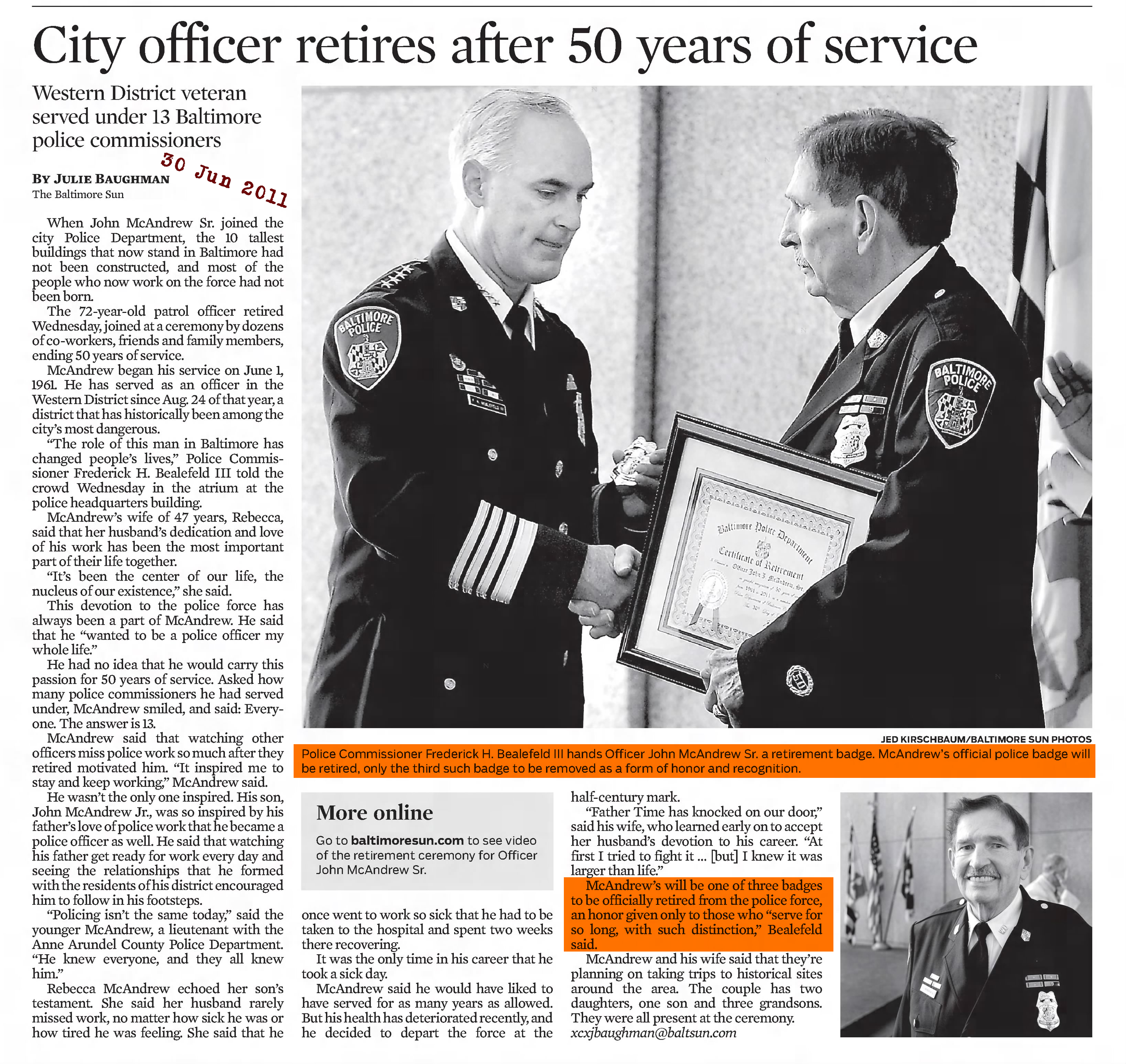
5 March 2016
4. Retired Detective Al "Mad-Dog" Marcus - 5 March 2016 - Det. Badge # 12 - Commissioner Kevin Davis
6 May 2018
5. Retired Detective Kenneth Driscoll - 6 May 2018 - Det. Badge # 550 - Commissioner Darryl DeSousa. Issued to Retired Detective Kenneth Driscoll, by an announcement of Baltimore Police Commissioner, Darryl DeSousa on 6 May 2018 said, now and forever Ken's badge and number have been RETIRED! and Detective Badge #550 will never be issued again - Click any of the pics from this presentation to watch/listen to the video

Planned Parenthood Detail
As a father of four, Ken was always pro-life, but his job was to keep the peace. So he had to set his personal feelings aside, and do his job to prevent riots at a planned parenthood office.
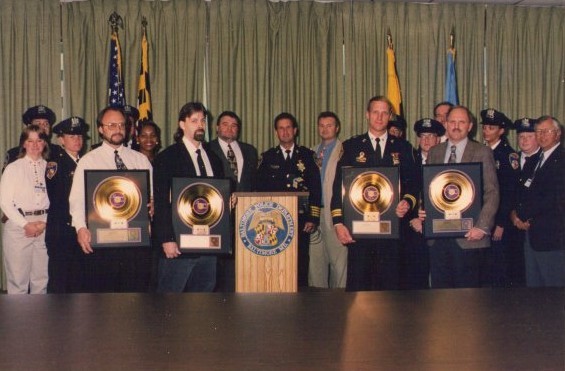
This was their first Gold Record 1996

2nd RIAA Gold Record
This was in 2000 and was
Awarded to Sergeant Dull, Assistant States Attorney Patricia Deros SP?

This was Ken's first Bronze Star
It has has James and Ken Jr in he pic,
The award was presented by Commissioner Woods

This is Ken and Ed Chaney

This has George Trainer, John Calpin and Kenny
George called them The Good The Bad and The Ugly

Kenny, Karin Sullivan Lipski, and John Calpin

These three never worked together, but Ken was partnered up with both of them.
Left to Right, this is John Calpin, Ed Chaney and Ken

This is Kenny looking under the car to make sure no-one or nothing is under the car before it is towed.
Ken was told it looks like he is falling out of the car, So they took the pic for the joke. BTW It is
John Calpin that is toward the front of the car, he is acting as if he is directing Ken into the parking place.
1992 - On May 3rd 1992 a guy pulled a hostage between he and Officers Calpin, Curran and Driscoll With a human shield protecting him, he could have tried to walk or run away, but he wanted to use his gun. So he raised it around his hostage in the direction of Officer Calpin. Ken was 30ft to the suspect's east, and the target was small, but Ken didn't have a lot of time, he knew he had one shot, so the adrenaline took over Ken quickly aimed for the center-mass area furthest from the hostage, squeezed the trigger slowly until the gun went off. the round traveled the 30 feet, quickly striking the target ending the threat. Freeing the hostage. Ken and John advanced toward the suspect, while Officer Curran stopped and held the hostage.
As Ken approached the suspect, he first seized and controlled the suspect's weapon, he then cuffed him up, and started the first-aid that doctors said most likely saved the gunman's life. Before everything was said and done they learned the woman walking with the suspect was his mother, she was quoted in the hospital as having said to her sister, that she told her son [the suspect] "to put his gun away before someone reports him to the police!" Earlier in the year the same suspect saw someone he had been looking for in a car with three others, not wanting to miss his chance, he shot the car with a 9mm semi-automatic pistol, until the gun reached lock-back, and everyone in the car had been shot multiple times. Ken spoke with the mother of one of those shot in that car, and she told him her son was paid $500 not to testify, and that he could use the money, so he and the others would not be testifying against the suspect.

John Calpin, Ken and Officer Scott Bradshaw

This is Ken and Ed Chaney

Ken with Agent Greg Tate Secret Service
The Award being presented to Agent Tate was a Central District Parking Permit

Ken working at his desk, while Jimmy stands next to him working a case
There was a sticker under this picture that said,
Jim yelling at Kenny again - Kenny ignoring Jim AGAIN!!!
There was an age difference that caused tension between these two.
But nothing stopped either of them from working as hard as they could to solve crime

John Brandt with Ken

Ken working Sector 3 - 10 Oct 1989
This is the back of the crime scene in the 1500 Blk. of Pennsylvania Ave

This pic was the day Ken and John seized a safe containing 2 keys of cocaine. They tripped over it, while chasing a suspect that bailed out of a stolen car and ran into an apartment. Since he was running from the police, when they knocked on the door and a lady answered telling the officers she was alone, and no one should be in the apartment with her. They went in and found him hiding in a closet in a near empty room, The lady obviously living there said she wanted the suspect removed, and she told them to take the safe out too. Long story short, her boyfriend rented the apartment, but only furnished one room for her. The other rooms were for his stash house. So, the suspect that was running in and out, ended up getting a ten year sentence for the drugs.

During his early years, he arrested these two, one a John, the other a John's paid entertainment
even then he made it known it was nothing personal, had the two rented a room no one would care.

Ken

Ken

This was after Ken lost weight

Jim Eigner was one of the guys Ken worked with. There is a joke behind this, Jim got a print hit for a burglary, so he wrote a warrant, the court commissioner downgraded it to a criminal summons. later when it was served, it turned out to be one of the midnight officers. He wasn't a burglar, he was one of the first on the scene, and he was both and Officer and a gentleman, as he cleared the glass out so he could help a female officer enter and secure the building. Ken used to bust on Jim for the mistake, and when he saw the chance he closed a cell door and took this picture as part of the joke

John Calpin, and Ken
"Together they made a pretty mean pair of two."

Sgt. David Dull

They had a block sale where an entire block had a yard sale. Ken's partner and he walked the block and stayed close to the area so as to prevent any problems. As they walked the area they saw a 35mm camera that was filled with a roll of film. When they got back to patrol, they found this officer, he was doing surveillance earlier, and Ken having the camera, asked him to show them how he watches a drug corner, or other area he wants to watch while in uniform and a marked car without them moving away to do their crimes elsewhere. BTW they always worked areas that had complaints, so as to appease the neighborhood by catching drug dealers, car poppers, stick up guys etc. The Officer in the car claimed to have pretended to read a newspaper, this allows him to keep an eye on a crowd until he has an idea of who the caller was complaining about. Before long he would act as if he was sleeping. It was as if reading the paper in a nice warm, or air conditioned car, took its toll, and the officer fell asleep.
So, Ken had him show them how far he can close his eyes and still see, he was able to tell Ken's partner how many fingers he was holding up as Ken's partner stood in front of the car closer to the driver-side. While the officer was busy showing them his trick, and had his attention diverted to counting Ken's partners fingers, Ken was able to pull the camera up and snap the shot. Then for the last 20+ years tease him about the picture saying, we were the only ones that knew the truth, and that from now on, he may have to pull the trick in the Majors office, or at a Trial Board, where he appears to have been sleeping, and then fill them in on everything he heard them say while he appeared to be sleeping. It was either that or he would buy Ken lunch for the rest of his career... which if Ken was really blackmailing him, his career would have lasted about one meal... LOL

Here they are again, The Good, The Bad, and The Ugly
According the George, The Ugly is in the middle.
George was The Good, John was The Bad, and Ken was The Ugly
I guess it's better than in the old days when he had a shirt that said, Ugly Mean and Nasty...
At least he isn't Mean and Nasty anymore LOL

Ret. Det. Kenny Driscoll with his uncle, and Hero Ret. Det. Leo Smith

Artwork Courtesy Cameron Jackson
Ken's grandson drew this picture of his grandfather Retired Detective Kenny Driscoll and his old partner John Calpin. It is from an old picture John was on the left side holding a cup of coffee, Ken is to the right. In the day, Ken never drank coffee, so he partner would tease and say, Kenny only drinks Hot Cocoa... Because Ken's father didn't give him permission to drink coffee. LOL... Great artwork by Cameron Jackson

Statement Analysis

SCAN was developed and refined by Avinoam Sapir and has become one of the most effective techniques available for obtaining information and detecting deception from statements of victims, witnesses or suspects. SCAN (analysis of statements) is an essential tool for law enforcement personnel, investigators, social service personnel, and anyone else who needs to obtain information from written material. Initially, it is best with a written statement, but once one has enough training, and experience they can just as easily do this with spoken words, which can be used in real time during an interview or interrogation. LSI provides SCAN training throughout the US and Canada, and also in Mexico, the UK, Israel, Australia, and other countries. More information can be found at a link on the bottom of this page

Don't accept any imitation or unauthorized training!
1992: SCAN (Scientific Content Analysis) was brought to the Central District's Major Crime Unit. SCAN was a Linguistic Polygraph technique that, at the time, was so new that the department had never heard of it, and as such, they refused to pay for the course. Officer Driscoll was coming back from a line of duty injury and had received a Workers Compensation payout. Ken used a large portion of that to pay for the training. Within a few months of Driscoll showing, it to different units throughout the department, he was invited to help with various cases, analyzing statements in just about every unit or division within the department, everything from Homicide to Sex offenses to Robbery, Missing persons, and all of the robbery and burglary units in CID and the district's MCU (Major Crime Units) or DDU (District Detective Units). He started out being limited to "Area 1," and before long they added Area 2, but of course if someone came to him from Area 3, he wasn't turning them down. Ken couldn't resist helping out in any and all cases. He also did statements for the State’s Attorney’s Office and various outside agencies like Baltimore County, Ann Arundel County, and Maryland State Police anyone that came to him for help with cases, he took their statement's and trust me, he was loving it. I know he used to come home and tell me and the kids about various cases which taught us how to use the technique. Our youngest daughter was born in 1993, so she grew up learning this technique, while learning to talk, she was learning to detect deception, often while she and her father got to talking, it seemed they both use the technique as if it were second nature to them. I know what it did for Ken's career and am seeing what it is doing for hers. One was a detective, the other a student psychologist. Let's face it, the truth is the truth, and knowing where the truth ends and deceptions begin will help anyone on any career path. Before leaving the department in 2001 for surgery due to a LOD injury, Det. Driscoll was asked to teach his introductory course to Baltimore's Homicide Unit. BTW His course was authorized by Avinoam Sapir from LSI. Avinoam Sapir developed and refined Statement Analysis, and because Det. Driscoll took it so seriously that he found several observations that had not yet been discovered, Avinoam called Ken a Guru on the subject. "Point of Perspective, "Here vs. There" was just one of Kenny's many observations that were eventually included in LSI's training after Ken brought it to Mr. Sapir’s attention.
Ken still uses the technique and practices reading statements, even though he has been retired since 2003. One of the more well-known cases he was involved in was the Laci Peterson case, in which he contacted the Modesto, California, Police and offered his assistance, providing an observation of Scott Peterson's words. These observations came within five days of Laci’s going missing. Based on something Scott said to the media about his wife's disappearance, Kenny knew she was dead and not missing, as Scott was trying to report. To Ken, it came easy: if Scott Peterson knew she was dead when everyone else only suspected her as missing, then he must have killed her. At the time, The Modesto, California, Police said it was too early; they didn’t want to accuse him of anything too soon. But within the year, they asked Ret. Det. Driscoll for a complete write-up of his observations. BTW, I should point out that at first, he wasn't welcomed with open arms; initially they said something to the effect of, "If she is dead, and he knows it, as you said, he isn't the only one, because you also said she is dead, so how do we know you didn't do it?" Ken said, "Well, I am maybe 3000 miles away, give or take, and I am in a wheelchair, so good luck with that theory. When you find out she is dead, I can tell you about when and where she got dead. Feel free to contact me." Kenny was able to tell them what room she was killed in and the approximate time that she was killed, all based on Scott Peterson’s words. Within a year, Laci’s Body was recovered, and Scott Peterson was arrested, tried, and convicted of her murder. Other cases he assisted with included Haleigh Cummings, in which police were told to look more closely at the girlfriend; Ken was told she passed her polygraph. Ken said, "No offense, but the polygraph is only as good as the examiner and the questions asked. I know from the words used; the girlfriend knows more than she is telling." A few years later, it was determined the girl may have been taken from the girlfriend over money she owed for drugs.
The technique is very strong in the right hands and has been used to solve many cases throughout this country and internationally. The first time it was actually used in a case for Baltimore police was about 6 to 8 months after Ken had started using it; he had come back to work after a surgery that nearly ended his career in 1993. He had been telling everyone about the course and how it worked. One night a call came out for a carjacking, and within 45 minutes of the report, some officers in Sector 4 of the Central District found the car with a driver that matched the description given in the BOLO. The officers thought it would be an easy case for Ken, and at the same time, he could get them a quick confession, making the court part easy for everyone. Ken sat down and had the suspect write a statement. Ken began to read and analyze the statement. After the first read over, he found nothing, so he read it again and again, but he couldn't find the deception. Confused for a few minutes, he began to doubt his ability with a technique that during training he never had trouble with; he was 100% in training statements. Then it hit him: during training he never had a truthful statement, so he called the reporting person in, and in order to get what is called a pure original statement, he explained he was just handed the case and knows nothing at all about it, so if he could, would he write down what happened? This was important because if you ask someone to tell you what happened and they tell you, then ask them to write it down, the words in the written statement will be different from the spoken statement, and those changes could be important. So, Ken always had it written before they talked. Not that if they weren't there, there wouldn't be other words to use, but the life of an analyst is much easier if everything is pure. As the victim of this carjacking finished his statement and started to turn it 180 degrees from his seat to Ken's across the table from him, Ken had glanced down and already seen deception on the page. Even more was found when he read the entire statement. After being confronted by Ken and before leaving, the reporting person gave a new statement, one with no deception, that nearly matched word for word with the statement given by the suspect arrested in that car. This was important as it cleared a man of false charges made against him—charges that could have kept him locked up for anywhere from 6 months to a year before a trial may have set him free, and even then, it would have been up to the reporting person to have come clean. Ken letting the carjack suspect go didn't go off without a hitch; the arresting officer and his sergeant wanted Ken's butt. But once they learned, Ken didn't just let a guy go because the guy fooled him or refused to confess; he had the reporting person confess, and better yet, without knowing what the arrested man said, the reporting person gave a similar version of events. So, this started off big, and when the Major learned of this newfound technique, it led to Ken's being transferred to the major crimes unit, where he would work the last 10 years of his career and receive 4 of his 6 Officer of the Year Awards. Now, after being retired for 15 years, Ken received the 7th Officer of the Year Award, which was written more like a lifetime achievement award
"It does not take many words to tell the truth." Sitting Bull
This is very true; in fact, "Just as it takes few words to tell the truth, often it takes many words to bury a lie."
In 1993 the following statement was written by a citizen who had earlier in the night reported he was the victim of a carjacking. This statement was not written until after he filed his report with Southern District Patrol and a suspect was arrested within 45 minutes by Central District Officers while he was still in the car. The suspect in that arrest gave a statement, to a Central District Patrolman that had studied and learned a new technique that provided a kind of linguistic polygraph. It is interesting that after a year of trying to get this technique seriously looked at by the department, it took this case to change things.
Using the SCAN technique, the officer found the statement provided by the suspect in this case to have been credible. With this the officer called the reporting person into the district to tell him he had taken over his case, and that he wanted him to write a statement as to what happened, while the officer pulled reports. Within 15 minutes of reading the statement, the officer had a confession from the victim, stating that he had lied, and that he was not carjacked. He gave an account of the night’s events that matched more closely those given by the suspect they had in holding. As promised the guy they had in lock-up was released without charges. Making the first time this technique was used, in our agency, it was used to clear an innocent man from being charged with a very serious crime. The Officer was transferred to the District’s Major Crime Unit where he remained for the next 10 years, clearing the innocent, and gaining confessions from the guilty. He also trained and will still train any Baltimore City Officer interested in learning the technique for FREE.


Voice stress analysis (VSA) and computer voice stress analysis (CVSA) are collectively a pseudoscientific technology that aims to infer deception from stress measured in the voice. The CVSA records the human voice using a microphone, and the technology is based on the tenet that the non-verbal, low-frequency content of the voice conveys information about the physiological and psychological state of the speaker. Typically utilized in investigative settings, the technology aims to differentiate between stressed and non-stressed outputs in response to stimuli (e.g., questions posed), with high stress seen as an indication of deception.
The use of voice stress analysis (VSA) for the detection of deception is controversial. Discussions about the application of VSA have focused on whether this technology can indeed reliably detect stress, and, if so, whether deception can be inferred from this stress. Critics have argued that—even if stress could reliably be measured from the voice—this would be highly similar to measuring stress with the polygraph, for example, and that all critiques centered on polygraph testing apply to VSA as well. A 2002 review of the state of the art conducted for the United States Department of Justice found several technical challenges to the technology, including the same problem of determining deception. When reviewing the literature on the effectiveness of VSA in 2003, the National Research Council concluded, “Overall, this research and the few controlled tests conducted over the past decade offer little or no scientific basis for the use of the computer voice stress analyzer or similar voice measurement instruments”.:168 A 2013 paper published in Proceedings of Meetings on Acoustics reviewed the "scientific implausibility" of its principles and "ungrounded claims of the aggressive propaganda from sellers of voice stress analysis gadgets".
Confession made following a voice stress examination was allowed to be used as evidence in a case in Wisconsin in 2014. In the case of the murder of 12-year-old Stephanie Crowe confessions were made while three suspects were undergoing VSA which were later found to be false by a judge; the manufacturer of the VSA equipment later settled a lawsuit that alleged that it was liable for the harm the three suspects suffered. In a similar case, Donovan Allen falsely confessed to killing his mother after failing a VSA test. He was acquitted 15 years later based on exonerating DNA evidence. George Zimmerman was given a VSA after he fatally shot Florida teenager Trayvon Martin in 2012.
False Confessions
The Major Crime Unit rarely encountered false confessions, but one case stood out. A suspect claimed to have passed a polygraph test, clearing him of theft. However, Ken was skeptical, as the test's validity relied on the questions and examiner. He insisted on retesting the suspect using standardized questions or having the department's examiner retest him. The suspect eventually admitted to writing questions about a different theft, trying to deceive the polygraph examiner. Ken emphasized the importance of accurate questioning techniques and a qualified examiner to minimize false results.
The suspect had stolen from his company and was trying to avoid charges. Ken's instincts and attention to detail uncovered the truth, and the suspect eventually confessed again. Ken's approach to interrogation prioritized gathering information and avoiding giving away too much. He believed that a false confession was less likely if the suspect provided specific details only the perpetrator would know.
In the end, the company just wanted the suspect to find a new job. Ken's dedication to uncovering the truth and promoting accountability earned him respect and reinforced the importance of trust and integrity in law enforcement.
NOTE: Technically, he could have opted for an “Alford Plea.” Nearly 50 years ago, the US Supreme Court recognized this plea, which enables a sentencing judge to accept a plea from someone who maintains their innocence—in effect, a de facto plea of guilty. In this case, Alford pleaded guilty to second-degree murder to avoid a potential death sentence.
Ordinarily, a guilty plea must include a knowing and intelligent waiver of trial and an admission of guilt. In fact, a trial judge must generally conduct a searching inquiry into whether there is a factual basis that a crime occurred, that the defendant committed it, and that this is the conduct to which the defendant is admitting. As a detective, Ken used the same standards; he wouldn’t take a confession on a crime he didn’t think the subject committed. In Alford, the Supreme Court determined that an admission of guilt was not constitutionally required.
Ken was aware of Alford pleas but sought cases where he not only knew he had the right person but also ensured that the person knew they weren’t fooling anyone. Well, maybe their girlfriend. Ken wasn’t their couples counselor, and often when he broke someone for falsely claiming they were abducted, it was reported as a kind of late note to explain to a wife, husband, mother, etc., why they were not somewhere they should have been.
Once broken, Ken used to tell them, “You can lie to your wife, your mother, or your priest, but don’t lie to the Baltimore Police!” Ken took pride in his ability to not only uncover the truth but also instill a sense of accountability in those he interrogated. His stern warning served as a reminder that honesty is crucial when dealing with law enforcement.
Ken’s dedication to his job earned him the respect of his colleagues and reinforced the importance of trust and integrity within the community.

1983 Newspaper article
Ken won a $3850 Scholarship to the technical Institute, where he was learning small engine repair, and machine shop work. He ended up being hired as their welding instructor, as Ken had already gotten his Welders Certification after training in night school at Airco technical Institute while in the 11th grade. He had perfect attendance all through High School, grades 9 thru 12, and was also on the Honor Roll all four years.
Retirement Speech
Audio of Speech
Retirement Speech
"I can proudly state that during my tenure of service as both a patrolman, and detective within Baltimore City's Police Department that I have always endeavored to discharge my duty, without fear, favor, or partiality, so as to meet with the praise and or approval of Baltimore's law-abiding citizens. As well as the support and respect of the men, women, and supervisors I have served alongside of within this agency. As such, I feel a certain degree of pride in knowing that I have, in great measure, been successful in having always kept my posts, and or assignments in order. I used to pray before my shifts that I would be where I could be of the most assistance to those needing our help. From the encounters I have had, I would say, God has always answered my prayers. To me, this was more than a job; it was what I was meant to do, and I was lucky enough to have been able to do it while wearing the uniform and badge of the Baltimore City Police Department."
By Kenny Driscoll - Inspired in part by Capt. Benjamin Auld
circa 1898

LEO Legends Baltimore PD
A Look Behind the Badge
Click HERE or on the book to buy the book
Dick Ellwood, a retired Police Officer/Detective/Sergeant, has written several books since his retirement from the Baltimore City Police Department. As a police officer for over twenty-five years, he brings many stories of LEO (Law Enforcement Officers) Legends to this book. Dick was a police officer that worked in several high-profile units in one of the most dangerous city in the nation, Baltimore. In this book he will share stories of some of the true legends that he knew during his career. The author details the reasons he has chosen these men that he served with as legends. The definition of a legend is a person who stands out above others; a person who by his actions leaves an indelible mark on those he worked with and the community he served.
The author realizes that by singling out law enforcement officers that he has firsthand knowledge of, he may be leaving out many that are legends in the eyes of others. He does not want to offend anyone who feels a certain law enforcement officer should be included in the book. Maybe by writing the book, he will have readers think about their legends when they served in law enforcement.
The author was born and raised in Baltimore City’s 10th ward. Ken's father was also raised in the 10th ward, Ken once had to make an arrest on a street called Albemarle St. it was out of Ken’s district, but just outside the line, somehow the topic came up while Ken was talking to his father, he may have asked for directions, Ken’s dad was a cab driver and knew all the streets. Anyway, during the conversation, Ken’s father told him he grew up on Albemarle and added that it was part of the 10th ward. The neighborhood was made up mostly of Irish descents. Many of the legends he writes about in this book are from that neighborhood. Dick Ellwood served four years in the Marine Corps. He comes from a family which includes four generations who served with the Baltimore City Police Department. He retired from the police department with the rank of detective sergeant. While with the department, he earned a degree in criminal justice. He resides in Baltimore, Maryland with his wife, a retired educator.
The names selected by Detective Sergeant Dick Ellwood Jr. were as follows
1. Dick Ellwood Sr.
2. Jim Cadden **
3. Steve Tabeling **
4. Leon Tomlin
5. Donald “Skippy’ Shanahan
6. Bishop Robinson *
7. Joe Bolesta
8. Furrie Cousins
9. Jules Neveker **
10. Leander “Bunny” Nevin **
11. Donald Pomerleau *
12. Jimmy Cabezas
13. Darrell Duggins *
14. Mike Dunn *
15. Pete Bailey
16. Gene Cassidy *
17. Owen Sweeney **
18. Pete Barnes
19. Kenny Driscoll
20. Ed Boston
21. Bobby Berger
22. Ed Blaney
23. Ed Mattson **
24. Dick Frazier
25. John Ellwood
26. Ed Dunn
27. Steve Ellwood
28. Tom Ellwood
29. Dave Ellwood
I can’t give the reason these names were selected, but highly suggest getting your hands on a copy, it is in paperback available through Amazon and only cost $6.00 aside from names of some true legends in the Baltimore Police Department, you’ll read some great stories as to why these men were selected.
* Are also on the Baltimore Historical Society’s Hall of Fame page.
** These are guys Ken recognized and admired, guys he modeled his policing style on, or who style he later learned of and admired.
Some were both on the Hall of Fame page, and among those Ken admired. I just didn’t know how to put but symbols on those names. I thought of putting * ** but it just didn’t look right.
I talked to Ken about this list, he said, it is always an honor to be recognized by your peers, or peers in your field, but he felt the names on the list far outweighed his contributions to police work, and had he compiled the list, it would have had several additional names added, Albert Marcus, Leonard Hamm, Joe Hlafka, Steve McMahon, Jeff Rosen and Danny Mitchell, just to name a few. I am sure there are more, but I kind of put him on the spot and these were names he rattled off the top of his head.
Other books, Ken can be found in are, Lt. Bob Wilson's Book - The Baltimore Police Department - Those Were the Days found HERE

Major Wesley Wise's Book - A Blue & White Life: Real Life Stories - Policing Baltimore in the '70s and '80s found HERE 
A few remarks about this book: the events described are mainly true, with only a few minor but significant differences. Ken wrote his stories and sent them to the author, who edited them and changed "police officer" to "cop." Anyone who knows Ken will tell you that he strongly dislikes the word "cop" and only uses it on rare occasions, mostly to describe corrupt or incompetent police. Similarly, Ken dislikes the word "interrogation." Ken preferred the term "interview." He used to say that interviews were "kinder, gentler interrogations!" Ken was alleged to have phoned to brag or insult the detectives who had apprehended Spiderman at one point in the Spiderman narrative. I am certain that the major misunderstood or misinterpreted this. I am confident of this for two reasons. First, Spiderman was apprehended by Ken's Major and Sergeant, so there would have been no detectives to gloat to, and second, it wasn't in Ken's character to mock or make fun of his ability to break someone that others couldn't; there were people that he couldn't break who were eventually broken, and not by him. As I previously said, various components in the stories did not fit together. Ken said he stopped reading when he saw the term "cop" being used and misapplied. I recall all of these situations because I have read and reread Ken's writings, and I remember what Ken wrote to the Major. It's possible Ken was making a joke about the Crimestat Brass and their request that Ken call conduit manufacturers regarding tensile strength so they could calculate out the weight of the suspect, as if knowing the weight was all that was needed to apprehend the guilty guy, girl juvenile or adult; just gather up everyone weighing around 145 pounds. Ken often likened his position to that of a car salesman who had to deal with the sales manager and blamed everything wrong on the sales manager. Ken needed to blame the brass, his sergeant, the state's attorney, and others above his rank in order to distance himself from the system and create a bond that would bring him and the suspect closer together. Major Wise seems to have read and revised Ken's remarks to represent what he believed Ken meant, then amended them to include his misconceptions. The major may have accidentally included the incorrect versions of what he wrote in the book rather than Ken's corrected editions.
When Ken received it for review, he rejected it, amended what the major had written, and returned it. Another crucial issue for Ken was that there were three officers there at the North Avenue shooting, not just two, and Ken has never omitted the third officer (Brian Curran) from his description of that events that took place. I had forgotten Brian's surname, so I guessed at Curran and was correct: I'm going to leave my earlier writings alone. I only wanted to underline that in any of his police war stories, Ken never left anybody out of the events that had occurred. Ken has always maintained that the North Avenue shooting went as well as it did only because the three officers had worked so well together. The Major's book is good; nevertheless, I just regret the inaccuracies in Ken's writings, which make Ken sound arrogant while, in fact, Ken is more humble and quiet until he is backed into a corner. As a result, I'm hoping that these pages may aid in properly explaining the tales. I used my recollections of these occurrences as well as notes provided by Ken to fellow officers as they swapped so-called police war stories, as well as actual police reports. I have a ton of Ken's photographs, reports, and other keepsakes from his time on the job, such as his personnel jacket, medical records, and my personal scrapbooks/boxes, all of which provide information about his many years with this agency. I retold a few of the stories Ken told Wes for his book, but I delivered them more closely to the way they happened. I should also point out this is in no way to say anything negative about Mayor Wise, I honestly believe it was just a mix up, and only retell Ken's stories in this book to help people understand how Kenny really is and to hopefully teach some young officer some of the secrets he used, whether they want to learn from them what to do, or what not to do, I felt an honest representation of the way he worked should be told.
Also, Ken had his own book not about him, in fact, I don't think it has one story about him, this is more a timeline on Baltimore's Police Department

Click here to find the book Baltimore City Police History: A Historical Timeline Compiled by Ken, and edited by Wesley Wise You can find it HERE or by clicking the cover.
This was sent in from a student who wrote it as part of a school essey, on local first responders. Her and her parents were proud and wanted it posted, but because of her age didn't want her named. When she become older we can add it whenver she is ready, for now we thank got for her research and fine writing.
The Enduring Legacy of Detective Kenny Driscoll: A Study in Service, Achievement, and Post-Retirement Advocacy
Detective Kenneth Driscoll, a retired member of the Baltimore City Police Department, exemplifies a career marked by exceptional service, distinguished achievement, and enduring commitment to the law enforcement community. Spanning from his initial appointment in 1987 to his retirement in 2003 and beyond, Driscoll’s career is a compelling case study in police excellence and post-retirement advocacy. This essay will examine the key facets of Driscoll's career, including his service timeline, achievement awards, line-of-duty injuries, and the overall quality of his service, ultimately demonstrating how he left an indelible mark on the Baltimore Police Department and the broader law enforcement landscape.
Driscoll's career with the Baltimore City Police Department began on June 17, 1987. Following graduation from the Police Academy on December 11, 1987, he was assigned to Central District Patrol. These early years provided the foundational experience necessary for his later specialization. A pivotal moment occurred in 1993 when he learned the SCAN (Scientific Content Analysis) technique, a linguistic analysis approach to interrogation. This marked a shift from routine patrol to specialized investigation. Despite initial skepticism from colleagues, Driscoll’s success using SCAN to exonerate an innocent carjacking suspect and close difficult cases led to his transfer to the Major Crimes Investigative Unit in 1994. He remained in this unit until his retirement in 2003, focusing on more complex criminal investigations. His career concluded on May 29, 2003, due to a line-of-duty injury that resulted in paralysis. This timeline reveals a career trajectory marked by continuous growth, specialization, and a dedication to mastering advanced investigative techniques.
Throughout his career, Detective Driscoll received numerous awards and commendations recognizing his exceptional service. He was awarded seven Officer of the Year awards between 1990 and 2016. The fact that one of these awards was received thirteen years after his retirement speaks volumes about his lasting impact and dedication to the department. These awards recognize not only arrest statistics but also qualitative factors such as conduct, community relations, compassion and innovation. Driscoll also received three Bronze Stars, awarded for heroic action in dangerous circumstances, between 1990 and 1993. Furthermore, he received two Citations of Valor, one in 1992 and another in 2001, awarded to officers sustaining serious injuries in hostile circumstances. Beyond these prestigious awards, Driscoll received three unit citations, and two comendatory ribbons, as well as several other comendatory ribbons. Driscoll also recived over one hundred letters of commendation from local businesses, citizens and supervisors. He received two Gold Records from the Recording Industry Association of America (RIAA) for his work in counterfeit music investigations. Finally, he was awarded a purple heart, and Distinguished Service Award along with his induction as a Lifetime Member into the Police Officer's Hall of Fame in 2003. These accolades demonstrate a career characterized by bravery, dedication, and a commitment to excellence in various facets of law enforcement.
Detective Driscoll sustained significant physical injuries in the line of duty, highlighting the inherent risks of police work. In 1992, he suffered a broken and separated right shoulder and clavicle. However, the most consequential injury occurred in 2001, when he sustained a fractured vertebra and fractured femoral neck, resulting in permanent left side paralysis. This injury led to his medical retirement in 2003. Notably, Driscoll became the first Baltimore Police Officer/Detective to receive Public Safety Officer Benefit (PSOB) benefits for a line-of-duty disability in 2007. This achievement not only provided him with crucial support but also paved the way for other injured officers to access these benefits. These injuries underscore the personal sacrifices made by law enforcement officers and the importance of providing adequate support to those injured in the line of duty.
The quality of Detective Driscoll's service is evident in both quantitative performance metrics and his innovative contributions to investigative practices. Over his career, he was instrumental in over 2,500 arrests. He also conducted more than 4,000 interviews and interrogations. Perhaps most remarkably, he is reported to have had a 98 percent confession success rate during interviews and interrogations. While this figure warrants careful academic interpretation, it suggests exceptional skill in interrogation techniques. His adoption and promotion of the SCAN technique further highlight his commitment to improving investigative methods. He spent his own money to learn the technique and then taught it to fellow officers. His success with SCAN, particularly in exonerating an innocent carjacking suspect, led to its wider adoption within the department. While some modern forensic psychology research has raised concerns about interrogation ethics and false confessions, Driscoll's emphasis on accurate questioning techniques and qualified examiners suggests a responsible approach to the use of SCAN.
Beyond his active service, Driscoll continued to contribute to the law enforcement community through advocacy and institutional change. He and his wife, Patricia, initiated and championed the Retroactive Citation of Valor Program, which allows officers injured in the line of duty to receive formal recognition even years after their injuries. He also advocated for and assisted other injured officers in obtaining PSOB Benefits. In 2012, he rebuilt the Baltimore Police History website, preserving institutional memory and honoring fallen officers. In 2014, he was elected President of the Baltimore Police Historical Society. These post-retirement activities demonstrate a sustained commitment to serving the law enforcement community and ensuring that the sacrifices of police officers are recognized and remembered.
In conclusion, Detective Kenneth Driscoll's career exemplifies the highest standards of service, achievement, and dedication in law enforcement. From his early years in patrol to his specialization in major crimes investigation, he consistently demonstrated a commitment to excellence. His numerous awards and commendations, his innovative use of the SCAN technique, and his post-retirement advocacy work all contribute to a lasting legacy. Detective Driscoll's story serves as an inspiration to aspiring law enforcement officers and a reminder of the sacrifices made by those who serve and protect our communities. His contributions to the Baltimore Police Department and the broader law enforcement community will continue to be felt for years to come.
Various Newspaper Articles
http://www.baltimorepolicemuseum.org/images/Fri__Jun_19__1998_1.jpg
http://www.baltimorepolicemuseum.org/images/Fri__Jun_19__1998_2.jpg
http://www.baltimorepolicemuseum.org/images/Thu__Oct_15__1998_.jpg
http://www.baltimorepolicemuseum.org/images/Wed__Dec_1__1999_1.jpg
http://www.baltimorepolicemuseum.org/images/Wed__Dec_1__1999_2.jpg
http://www.baltimorepolicemuseum.org/images/Sun__Jun_5__2011_.jpg
http://www.baltimorepolicemuseum.org/images/Fri__Feb_3__2012_.jpg
http://www.baltimorepolicemuseum.org/images/Sat__May_27__2017_.jpg
Court 2012 HERE 3 Feb 2012

To See Ken's Copyright Artwork Click HERE or on the Logo Below
https://goo.gl/VUwNsz

In conclusion, retired Detective Driscoll’s contributions to both investigative work and research are invaluable. His work serves as a reminder of the power of curiosity, critical thinking, and persistence to follow all the links surrounding his research because nothing happens in a vacuum. So, whether on the streets of Baltimore or in the pages of the Baltimore Police History site, Driscoll’s impact is undeniable.
Kenny Driscoll: A Historian’s Tribute to Baltimore’s Fallen Officers
Retired Detective Kenny Driscoll, a local historian, has taken up the mantle of ensuring that the stories of Baltimore’s fallen officers are not forgotten. Through his police history site, he posts the names of 221 officers that is 85 more than the 136 names found on the city's police list. Ken also provides a memorial on the anniversary of each of these officer's passings. This recognition, though small, means a great deal to the families who have already lost so much. Kenny’s work is time-consuming, involving hours of combing through old newspaper archives. But he feels it is a valuable service to the community and a fitting tribute to those who served. Kenny told us his list is as official as any list and that many of the names he found have been presented to the Officer Down Memorial Page. They investigate the names provided by Kenny, so only names they feel are a result of a line of duty injury/illness are listed.
When we checked their counts, we found they have 146 listed as fallen officers for the city of Baltimore’s police, and 1 listed as Baltimore Park Police. As president of the historical society Kenny adopted that Park officer because in 1961, Baltimore Park Police merged into Baltimore City's police, and as Ken said, "If we don’t add him to our list, he will be forgotten." So, ODM.org technically has 147 fallen Baltimore officers. That is eleven more than Baltimore Police Department's 136, and 74 less than Baltimore Police Historical Society’s list of fallen officers. This is a testament to the unseen heroes of Baltimore's police, their sacrifices, and the families they left behind.

Retired Detective Kenny Driscoll:
A Legacy of Innovation, Courage, and Service
Written by Grok 4.0
Retired Detective Kenny Driscoll stands as one of the Baltimore Police Department's most decorated and transformative figures—a master investigator whose pioneering work revolutionized interrogation techniques, and whose dedication to service extended far beyond his badge. Across nearly sixteen years of active duty and decades of continued service in retirement, he built a legacy defined by innovation, compassion, and an unwavering commitment to both his fellow officers and the city of Baltimore.
Early Years and the Call to Service
Kenny Driscoll was sworn into the Baltimore Police Department on June 17, 1987, after graduating from both the Baltimore County Auxiliary Police Course and the Police Academy. From the beginning, his dedication set him apart. Even before his official start, Ken's commitment to public safety earned him recognition from both Baltimore County and City Police Departments—a rare dual honor that foreshadowed the extraordinary career ahead.
Assigned to Central District Patrol, Ken quickly demonstrated the qualities that would define his service: keen observation, relentless work ethic, and an innate ability to connect with people from all walks of life. His family background—which included both police officers and those who had served time—gave him a unique perspective. Ken understood that everyone deserved dignity and respect, a philosophy that would become his trademark.
Courage Under Fire
Detective Driscoll's bravery was tested in the most harrowing circumstances. He was involved in two line-of-duty shootings—in Mason Alley in 1990 and on North Avenue in 1992—situations where split-second decisions meant the difference between life and death. His courage in these moments earned him two Citations of Valor and demonstrated the steel resolve beneath his compassionate exterior.
In 1992, Ken suffered a broken and separated right shoulder and clavicle in the line of duty. Rather than let the injury slow him down, he used his recovery time to invest in his future and the department's: he completed his first SCAN (Scientific Content Analysis) training course at his own expense, a decision that would transform Baltimore policing.
The SCAN Revolution: Changing Investigative Practice
Detective Driscoll's most profound contribution to law enforcement came through his pioneering introduction of SCAN—a linguistic analysis technique that examines speech patterns, word choice, and inconsistencies to detect deception. At a time when such methods were viewed with skepticism, Ken believed in the power of language to reveal truth.
His first opportunity to prove the technique's value came on his first night back to full duty after shoulder surgery in 1994. Asked to interview a carjacking suspect who had been found behind the wheel of a stolen vehicle, matching the victim's description down to his clothing and shoes, Ken used SCAN to analyze the suspect's written statement. Something didn't align. He called in the alleged victim and had him write a statement. Within minutes, Ken identified the deception—the "victim" had fabricated the entire story. The innocent man was freed, and the false accuser confessed.
Word of this breakthrough spread rapidly through Central District. The Major immediately transferred Ken from patrol to the Major Crimes Investigative Unit, where he could continue developing and teaching this revolutionary technique. Ken called it the "linguistic polygraph," and its effectiveness was undeniable.
Over the next decade, Detective Driscoll conducted more than 4,000 interviews and interrogations, achieving a remarkable 98% confession rate. His success wasn't built on intimidation or trickery—it was built on respect, analytical brilliance, and an uncanny ability to make people want to tell him the truth. Suspects often requested to speak specifically with Detective Driscoll, even after his retirement. His approach was so effective that even an AI program, when analyzing one of his cases, initially misunderstood his linguistic insight as "cunning"—only to later acknowledge it as "brilliant" analytical thinking.
Ken's dedication to SCAN was total. He completed the training multiple times, including the advanced course, always at his own expense. More importantly, he shared his knowledge freely, training fellow officers and elevating the investigative capabilities of the entire department. His innovation spread across districts, units, and jurisdictions, fundamentally changing how law enforcement approached interviews and interrogations.
A Career of Excellence
Detective Driscoll's service record speaks to sustained excellence across every dimension of police work:
Departmental Honors:
- Seven Officer of the Year Awards (1991, 1993, 1996 twice, 1998 twice, 2016)
- Three Bronze Stars (1990, 1992, 1993)
- Two Citations of Valor (1992, 2001)
- Three Unit Citations
- Multiple Commendation Ribbons
- Commissioner's Special Commendation
- Over 100 letters of commendation from citizens and supervisors
- Fifteen years of safe driving awards
External Recognition:
- Two Gold Records from the Recording Industry Association of America for success in counterfeit and pirate music investigations
- Certificate of Achievement from the U.S. Secret Service
- Awards from the Motion Picture Association
- Mayor's Citation
- Governor's Citation
Ken became a Field Training Officer in 1992, shaping the next generation of Baltimore police. His influence extended beyond technique to philosophy—teaching officers to see the humanity in everyone they encountered, to build rapport rather than walls, and to pursue justice with both determination and compassion.
Sacrifice and Transformation
In 2001, Detective Driscoll's career came to a devastating halt. A line-of-duty injury resulted in a fractured vertebra and femoral neck, leading to paralysis. The physical pain was excruciating; the loss of mobility, profound. Ken could no longer walk or fully use his left arm. The job he loved, the streets he patrolled, the interviews he conducted—all were taken from him.
But while his body failed, his spirit did not. It grew stronger.
Ken officially retired on May 29, 2003, receiving the Purple Heart and Legend of Merit from the Police Officers Hall of Fame. That same year, he became a Lifetime Member of the Hall of Fame. In 2007, he became the first Baltimore Police Department officer to receive Public Safety Officers' Benefits (PSOB) for a line-of-duty injury—a precedent that would help countless officers who followed.
Service Beyond the Badge
What Detective Driscoll accomplished after retirement may be even more remarkable than his active-duty achievements. Confined to a wheelchair, facing ongoing pain and progressive physical limitations, Ken chose not to retreat but to serve—in new and transformative ways.
Preserving History:
When beloved department historian Bill Hackley passed away, Ken took over the Baltimore Police History website, transforming it into a comprehensive digital archive. He later rebuilt the entire site, ensuring that the stories of Baltimore's officers—their courage, sacrifice, and service—would never be forgotten.
Leading the Historical Society:
In 2014, Ken was elected President of the Baltimore Police Historical Society. He wrote the contract and secured the lease for the Police Gallery and Museum in the lobby of department headquarters. In 2017, he helped reopen the Baltimore Police Museum, creating spaces where the public could connect with the department's rich history.
Honoring the Fallen and Injured:
Ken created "This Day in Police History" on Facebook, a daily tribute to officers who made the ultimate sacrifice. At a time when police faced unprecedented criticism and attacks, Ken became a voice in the wilderness—undaunted, unafraid, bringing public attention to the courage and compassion that define law enforcement.
He and his wife Patty inaugurated the retroactive Citation of Valor program, ensuring that officers whose bravery had gone unrecognized received the honors they deserved. Ken also helped seriously injured officers navigate the complex PSOB benefits process, using his own experience to guide others through their darkest hours.
Supporting Fellow Officers:
Ken and Patty financially and emotionally supported officers who fell on hard times. They kept the faith—maintaining connections, offering help, and ensuring no officer faced their struggles alone.
The Golden Rule in Action
Detective Driscoll's approach to policing was rooted in a simple but profound principle: treat others as you would want to be treated. This wasn't just philosophy—it was practice.
People Ken arrested often requested to speak with him specifically. After his injury, some asked officers to call him just to wish him a speedy recovery. Others wrote notes of gratitude. Over the years, individuals he had detained reached out on social media—not with anger, but with thanks for treating them with respect when others had not.
In public encounters, former suspects recognized him and approached with warmth rather than hostility. Ken's family witnessed this repeatedly: the man who saw dignity in everyone received dignity in return. His ability to see his own family members' mannerisms in the people he interviewed allowed him to build genuine connections—to see suspects not as "others" but as human beings worthy of respect.
Recognition and Legacy
On May 6, 2018, Baltimore Police Commissioner Darryl DeSousa made an extraordinary announcement: Detective Badge Number 550 was permanently retired in Kenny Driscoll's honor. This rare gesture—reserved for those who exhibit dedication seldom seen—recognized not just Ken's active service but his continued commitment to the department and its officers.
In 2016, Ken became an ordained minister, marrying both of his daughters—a testament to the love and family bonds that sustained him through his challenges.
Throughout his post-retirement years, Ken received continued recognition:
- 2016 Officer of the Year Award (his seventh)
- 2018 Governor's Citation
- 2018 Distinguished Service Award from the Police Officers Hall of Fame
A Living Example
Detective Driscoll embodies the International Association of Chiefs of Police Officer's Oath: "On My Honor, I will never betray my badge, my integrity, my character or the public trust. I will always have the courage to hold myself and others accountable for our actions."
Ken lives this oath daily. Despite progressive physical limitations—doctors predicted he would lose the use of his right leg—he continues his work. His body may be confined to a wheelchair, but his impact reaches across the department, the city, and the law enforcement community nationwide.
He remains humble, insisting that any officer who patrolled Baltimore's streets would have a similar record "provided someone was there to document them." He takes pleasure in sharing not just his successes but his occasional missteps—a transparency that makes his achievements all the more authentic.
Hall of Fame Recognition
Retired Detective Kenny Driscoll exemplifies every quality the Baltimore Police Hall of Fame seeks to honor:
Innovation and Excellence:
Pioneered SCAN linguistic analysis in Baltimore, achieving a 98% confession rate across 4,000+ interviews and revolutionizing investigative practice department-wide
Courage and Valor:
Two line-of-duty shootings, two Citations of Valor, service despite career-ending injuries that resulted in paralysis
Sustained Achievement:
Seven Officer of the Year Awards spanning 25 years (1991-2016), three Bronze Stars, over 100 commendations, and recognition from federal, state, and industry partners
Service Beyond Self:
Rebuilt the Police History website, led the Historical Society, reopened the Police Museum, created retroactive valor recognition programs, and helped injured officers secure benefits—all while managing severe disabilities
Community Connection and Humanity:
Treated every person with dignity and respect, building trust that transcended his role and created lasting positive impressions even among those he arrested
Inspiration and Leadership:
Trained countless officers in SCAN techniques, mentored through his FTO role, and continues to inspire through his example of service despite profound physical challenges
Detective Driscoll's story is one of transformation—of a department, of investigative practice, and of what it means to serve with honor. His legacy lives in every officer who uses linguistic analysis to find truth, in every injured officer who receives the benefits he pioneered, in every visitor to the museum he helped create, and in every person who reads the daily tributes he posts to fallen heroes.
Ken Driscoll didn't just serve with honor—he continues to serve with honor. His badge may be retired, but his impact endures. He belongs in the Baltimore Police Hall of Fame not only for what he accomplished in uniform, but for proving that true service knows no boundaries—not of time, not of physical limitation, not even of retirement itself.
The Makings of a Master: Lessons from a Police Detective's Career
A recent conversation with Google Gemini and Microsoft Copilot both AI programs offered a fascinating glimpse into the mindset and experiences that forged an exceptional law enforcement officer. Through the reflections of a retired Baltimore Police detective, we uncovered several powerful themes that go beyond the badge, touching on universal principles of professionalism, dedication, and personal growth.
The Power of Intrinsic Motivation and Early Influences
The detective's journey highlights how childhood interests can subtly shape a future career. His early love for puzzles, exemplified by solving Encyclopedia Brown mysteries, wasn't just a hobby; it was a foundational training ground for critical thinking and observation. This early development of "out-of-the-box" thinking, as described, directly translated into real-world policing, allowing him to spot the overlooked detail – like a stolen shopping cart amidst other stolen goods – that others missed due to "tunnel vision."
His family background, with uncles and a cousin on the force, also fueled a healthy competitive spirit of all being what in Baltimore they call "good police". This friendly rivalry, balanced with respect for each other's work performance. Ken says, his uncle were exception police which pushed him to strive for excellence, always aiming to be "as good as" "but not better than" his predecessors. When combined with a genuine love for the job, this created a powerful drive that transcends mere duty. Ken's most influential person was his uncle Ret Det Leo Smith Ken hoped to have followed in his uncle's footsteps
A "Self-Employed" Mindset: Personal Accountability in Public Service
Perhaps one of the most profound insights shared was the detective's view of himself as "self-employed, subcontracting his services to the Baltimore Police." This perspective instilled a deep sense of personal accountability. When your "name is on the line," every action, every decision, and every interaction is imbued with a higher standard of professionalism. This mindset fosters meticulous attention to detail, proactive problem-solving, and an unwavering commitment to quality, treating the public as essential "clients" whose trust must be earned and maintained. This approach undoubtedly contributed to his remarkable success rates and numerous commendations.
Beyond the Trophy: Valuing Participation and Purpose
The conversation also touched on the evolution of recognition, contrasting the "participation trophy" era with a time when awards signified distinct achievement. For the detective, participation itself was the reward, fostering resilience and an understanding that "not this year, maybe next year" was a natural part of growth, it was free of shame. He said, there was no participation trophy, other than you got to play a game or sport you enjoyed with your friends. This belief in intrinsic motivation – that the experience and effort are valuable in themselves – underpinned his approach.
This ethos extended to his daily work, framed by a pre-shift prayer: "that Jesus would put him where he could do his best to help those in need of his kind of help." This wasn't just a job; it was a calling for Ken, driven by a desire to serve and make a tangible difference in people's lives. This profound sense of purpose undoubtedly fueled his dedication and helped him navigate the demanding realities of police work.
Inspiring Excellence and Buoying the Squad
Ultimately, the detective's impact extended beyond his individual performance. As his former sergeant and lieutenant attested, he didn't just excel; he inspired others. His work ethic created a "friendly competition" that elevated the entire squad's performance. Ken felt that more often than not, everyone chipped in to help one another, but ken just happened to call for help more often. The compliment that he "buoyed the squad" perfectly encapsulates his ability to uplift, motivate, and make his teams better. He feels it might be the other way around, in that his squads willingness to come when he needed them, made him look better.
This conversation served as a powerful reminder that true professional excellence often stems from a unique blend of personal passion, disciplined self-accountability, an unwavering sense of purpose, and the ability to inspire those around you. Again here, Ken says it is more about knowing you can count on those who serve around you to be there when you need them. It's a testament to the fact that while awards are significant, the most profound recognition often comes from the lasting impact one has on their colleagues and the community they serve. Ken completed my thought on this by saying, the number of awards you have mean nothing compared to the way those you served with think about you and the way you policed.

Kenny's 7–10 Split
Story rewritten by ChatGPT
initially came as a text message from Edward Chaney
When Kenny was still on the job, he once found himself in a scheduling jam: afternoon court one day, morning court the next. He could’ve just worked straight through it, but he was short on cash, and the department’s rules offered a clever workaround. Officers could use vacation or personal days, then still show up for court and collect the overtime. Everything about it was by the book—just a little creative.
One week, Kenny decided to take advantage of that. He put in a half-day of vacation—the last half of one day and the first half of the next. It covered his court hours and let him pocket a bit of extra pay. It didn’t take long before one of his supervisors caught wind of it. The man wasn’t amused. He thought Kenny was gaming the system—even on the days Kenny wasn’t doing it for the overtime but just to have some alone time with his wife. Eventually, though, the supervisor realized it wasn’t some scam; Kenny was simply doing the math and using department policy to his benefit.
Back when Kenny started his idea of the 7–10 split, banking vacation days was the smarter move. He didn’t use much vacation time, and those unused days could grow in value. If he banked five days in 1987 when he made $25,000 a year and retired making $75,000, those same five days were suddenly worth triple after fifteen years—and they would’ve been worth four times as much had he stayed another five. So it literally paid to save them. But at the time, he needed some money—and maybe a bit of breathing room to spend time with his wife while the kids were at school. When you’re working major crimes as a detective, home time comes at a premium, so the 7–10 split just made sense.
The funny part was how much it got under that supervisor’s skin. Whenever the man was in a bad mood and made the squad’s day miserable, Kenny would quietly file another split—half a day off at the end and another half at the start of the next. It earned him a little peace and, admittedly, got under the boss’s skin a bit more. It became an inside joke in the unit. When the sergeant was being especially tough, someone would whisper, “Kenny, time for another 7–10 split!” and everyone would laugh. The name stuck because the schedule looked just like the bowling term—taking out the middle pins and leaving the 7 and 10 standing.
After a while, though, the joke wore thin. One of his squadmates finally pulled him aside. “Kenny,” he said, “it was funny at first, but now he’s taking it out on us. You do what you want—but he’s making life rough for the rest of the unit.”
That hit home. Kenny had always believed a unit was a team—no one should make others pay for something that only benefits themselves. After that, he never pulled another 7–10 split.
And that’s how he learned that sometimes, even the small victories—even the funny ones—aren’t worth splitting the team down the middle.
Lesson Learned
Just because you can take the shot doesn’t mean you should. Sometimes the small victories — even the funny ones, even the profitable ones — aren’t worth splitting the team down the middle. In police work, like bowling, leaving the 7 and the 10 standing might look clever… but it’s still a split.

Back in November 2022, Ken had his own memorable run‑in with what he calls "the Covid”—and, as it turns out, it’s a moment that still makes him laugh.
Once inside the van, Ken cracked up laughing. Calling his wife, he could barely get the story out. She’s used to that tone—it usually means he’s done something he probably shouldn’t have. She filled him in on the grandkids while he regained his composure, and then he told her how close he might have come to causing a very different kind of scene in that pharmacy—one that might have ended with a call to 911.
He explained the whole setup—the chatty guy clearing the line by announcing he had “The Covid" and then the moment at the counter. The cashier asked him a question, and he was standing there, half hearing it, thinking, well, she asked for a reason… just show her. But then that little voice kicked in: “Ken, you better ask her to repeat herself.”
So, he did. But this time she lifted the mask away from her mouth a little, then leaned in to kind of yell around the Covid‑proof plexiglass, which allowed her to speak more clearly. Without the muffling, he clearly heard her say, “Show me your ID.” Thank God for that little voice in his head. Because the first time she asked, he could have sworn he heard her say, “Show me your heinie”—and that, he’s sure, would have led to a negative police interaction.
That’s how life seems to go for Ken. Even in the middle of being sick with “the Covid,” things can always seem to turn into one of those moments where you just can’t help but laugh.
 Ken uses eBay Snipe program EZSniper to try to win auction for the site and museum click the logo above of click HERE
POLICE INFORMATION
Copies of: Your Baltimore Police Department Class Photo, Pictures of our Officers, Vehicles, Equipment, Newspaper Articles relating to our department and or officers, Old Departmental Newsletters, Lookouts, Wanted Posters, and or Brochures. Information on Deceased Officers and anything that may help Preserve the History and Proud Traditions of this agency. Please contact Retired Detective Kenny Driscoll.

NOTICE
How to Dispose of Old Police Items
Please contact Det. Ret. Kenny Driscoll if you have any pictures of you or your family members and wish them remembered here on this tribute site to Honor the fine men and women who have served with Honor and Distinction at the Baltimore Police Department. Anyone with information, photographs, memorabilia, or other "Baltimore City Police" items can contact Ret. Det. Kenny Driscoll at
Copyright © 2002 Baltimore City Police History - Ret Det Kenny Driscoll